Key indicators
Summary of 8 most important relocation metrics. Green arrow = Guangzhou wins, red = Moscow wins.
Quality of life profile
8-dimensional radar: the larger the area, the better the city overall. All axes are normalized so 'larger = better'.
Everyday prices
Direct prices in site currency (RUB, with CNY conversion in parentheses).
City metrics: infrastructure
Comparison of Moscow and Guangzhou infrastructure: area, metro, train stations, airports, universities, stadiums, pools, fitness clubs and more. Sources: Wikipedia, municipal statistics bureaus, World Population Review.
📊 General facts
🚇 Transport infrastructure
🏛️ Education, culture, sports, leisure
Population: age, gender, nationalities
Demographic profile of Moscow and Guangzhou. Moscow is an aging European city with female majority. Guangzhou is a young migrant city with male majority (due to commuter migration of workers from other Chinese provinces). Sources: Rosstat, Guangzhou Statistics Bureau, World Population Review.
Age structure of population
Moscow is an aging city: median age 40.4 years, 11.8% over 65. Guangzhou is young: median age 32.1, just 3.5% over 65. This is explained by huge commuter migration of 18–35-year-old workers from other Chinese provinces. The largest group in Guangzhou is 25–34 years (27.8%), while in Moscow it's 25–34 (18.4%) and 35–44 (17.1%).
🇷🇺 Moscow — gender
100%Moscow has a typical European city ratio: more women (53.5%), fewer men (46.5%). This is due to women's longer life expectancy and the fact that young men more often leave for other regions.
🇨🇳 Guangzhou — gender
100%Guangzhou is an anomaly: more men (53.7%), fewer women (46.3%). This is because many internal migrants from other provinces are young men who came to work in factories and construction. The ratio equalizes with age.
🇷🇺 Moscow — ethnic composition
130+ nationalitiesMoscow is a multinational city, but Russians make up 92%. The remaining 8% are predominantly from former Soviet republics (Ukraine, Armenia, Tatarstan, Uzbekistan, Tajikistan, Azerbaijan, Belarus, Moldova, Kyrgyzstan). Moscow has 130+ registered nationalities, but each has a small share.
🇨🇳 Guangzhou — origin by province
mostly HanGuangzhou is a migrant city: 78% of residents were born in other Chinese provinces. Ethnic composition is almost homogeneous (98% Han), but cultural diversity is huge — people from different provinces speak different Chinese dialects (Cantonese, Hakka, Sichuan, Hunan). Foreign expats are only ~1% (~50,000 people), mostly from the US, Japan, Korea and Europe.
Cost of living
57 metrics across 10 categories. All prices in RUB (with CNY and USD in parentheses) — native aggregated format. Each category shown with its own chart and full table — no hidden tabs, everything visible at once. Conversion rate: $1 ≈ ₽79.5 · ¥1 ≈ ₽10.9.
Sports & Leisure
Full table
3 items| Item | 🇷🇺 Moscow ₽ | 🇨🇳 Guangzhou ₽ | 🇷🇺 Moscow ¥ | 🇨🇳 Guangzhou ¥ | 🇷🇺 Moscow $ | 🇨🇳 Guangzhou $ | Diff |
|---|---|---|---|---|---|---|---|
| Fitness Club (monthly) | ₽3,294.42 | ₽3,540.68 | ¥303 | ¥326 | $42 | $45 | ↑ 7.5% |
| Tennis Court (1hr, weekend) | ₽3,440.00 | ₽1,179.75 | ¥316 | ¥109 | $43 | $15 | ↓ 65.7% |
| Cinema Ticket (intl release) | ₽700.00 | ₽535.71 | ¥64 | ¥49 | $9 | $7 | ↓ 23.5% |
Clothing & Shoes
Full table
4 items| Item | 🇷🇺 Moscow ₽ | 🇨🇳 Guangzhou ₽ | 🇷🇺 Moscow ¥ | 🇨🇳 Guangzhou ¥ | 🇷🇺 Moscow $ | 🇨🇳 Guangzhou $ | Diff |
|---|---|---|---|---|---|---|---|
| Jeans (Levi's 501 or similar) | ₽7,229.44 | ₽2,876.25 | ¥665 | ¥265 | $91 | $36 | ↓ 60.2% |
| Summer Dress (Zara/H&M) | ₽4,965.52 | ₽2,595.45 | ¥457 | ¥239 | $63 | $33 | ↓ 47.7% |
| Nike Running Shoes (mid-range) | ₽11,142.86 | ₽5,154.59 | ¥1 025 | ¥474 | $140 | $65 | ↓ 53.7% |
| Men's Leather Business Shoes | ₽13,652.17 | ₽6,971.18 | ¥1 256 | ¥641 | $172 | $88 | ↓ 48.9% |
Rent (Monthly)
Full table
4 items| Item | 🇷🇺 Moscow ₽ | 🇨🇳 Guangzhou ₽ | 🇷🇺 Moscow ¥ | 🇨🇳 Guangzhou ¥ | 🇷🇺 Moscow $ | 🇨🇳 Guangzhou $ | Diff |
|---|---|---|---|---|---|---|---|
| 1BR Apartment, City Centre | ₽118,714.29 | ₽56,970.29 | ¥10 922 | ¥5 241 | $1 496 | $718 | ↓ 52.0% |
| 1BR Apartment, Outside Centre | ₽62,583.33 | ₽37,175.48 | ¥5 758 | ¥3 420 | $789 | $468 | ↓ 40.6% |
| 3BR Apartment, City Centre | ₽246,923.08 | ₽136,140.28 | ¥22 717 | ¥12 525 | $3 111 | $1 715 | ↓ 44.9% |
| 3BR Apartment, Outside Centre | ₽119,464.29 | ₽65,989.30 | ¥10 991 | ¥6 071 | $1 505 | $831 | ↓ 44.8% |
Buy Apartment
Full table
2 items| Item | 🇷🇺 Moscow ₽ | 🇨🇳 Guangzhou ₽ | 🇷🇺 Moscow ¥ | 🇨🇳 Guangzhou ¥ | 🇷🇺 Moscow $ | 🇨🇳 Guangzhou $ | Diff |
|---|---|---|---|---|---|---|---|
| Price per m², City Centre | ₽822,841.09 | ₽951,781.86 | ¥75 701 | ¥87 564 | $10 368 | $11 992 | ↑ 15.7% |
| Price per m², Outside Centre | ₽358,980.14 | ₽443,877.30 | ¥33 026 | ¥40 837 | $4 523 | $5 593 | ↑ 23.6% |
Salaries & Financing
Full table
3 items| Item | 🇷🇺 Moscow ₽ | 🇨🇳 Guangzhou ₽ | 🇷🇺 Moscow ¥ | 🇨🇳 Guangzhou ¥ | 🇷🇺 Moscow $ | 🇨🇳 Guangzhou $ | Diff |
|---|---|---|---|---|---|---|---|
| Avg Monthly Net Salary (after tax) | ₽147,063.47 | ₽121,846.49 | ¥13 530 | ¥11 210 | $1 853 | $1 535 | ↓ 17.1% |
| Mortgage Interest Rate (20yr, %) | 20.32 | 3.44 | ¥2 | ¥0 | $0 | $0 | ↓ 83.1% |
| Contributors in the past 12 months: | 438 | 97 | ¥40 | ¥9 | $6 | $1 | ↓ 77.9% |
Restaurants
pastel tonesFull table
8 items| Item | 🇷🇺 Moscow ₽ | 🇨🇳 Guangzhou ₽ | 🇷🇺 Moscow ¥ | 🇨🇳 Guangzhou ¥ | 🇷🇺 Moscow $ | 🇨🇳 Guangzhou $ | Diff |
|---|---|---|---|---|---|---|---|
| Meal, Inexpensive Restaurant | ₽1,000.00 | ₽268.12 | ¥92 | ¥25 | $13 | $3 | ↓ 73.2% |
| Meal for Two, Mid-range (3 courses) | ₽5,000.00 | ₽2,145.00 | ¥460 | ¥197 | $63 | $27 | ↓ 57.1% |
| McMeal at McDonalds | ₽600.00 | ₽375.37 | ¥55 | ¥35 | $8 | $5 | ↓ 37.4% |
| Domestic Beer (0.5L draught) | ₽400.00 | ₽107.25 | ¥37 | ¥10 | $5 | $1 | ↓ 73.2% |
| Imported Beer (0.33L bottle) | ₽400.00 | ₽136.74 | ¥37 | ¥13 | $5 | $2 | ↓ 65.8% |
| Cappuccino (regular) | ₽291.56 | ₽214.01 | ¥27 | ¥20 | $4 | $3 | ↓ 26.6% |
| Coke/Pepsi (0.33L bottle) | ₽126.32 | ₽38.16 | ¥12 | ¥4 | $2 | $0 | ↓ 69.8% |
| Bottled Water (0.33L) | ₽66.78 | ₽22.89 | ¥6 | ¥2 | $1 | $0 | ↓ 65.7% |
Markets
Full table
19 items| Item | 🇷🇺 Moscow ₽ | 🇨🇳 Guangzhou ₽ | 🇷🇺 Moscow ¥ | 🇨🇳 Guangzhou ¥ | 🇷🇺 Moscow $ | 🇨🇳 Guangzhou $ | Diff |
|---|---|---|---|---|---|---|---|
| Milk (1L) | ₽101.49 | ₽122.38 | ¥9 | ¥11 | $1 | $2 | ↑ 20.6% |
| White Bread (500g) | ₽80.35 | ₽131.72 | ¥7 | ¥12 | $1 | $2 | ↑ 63.9% |
| White Rice (1kg) | ₽133.28 | ₽90.87 | ¥12 | ¥8 | $2 | $1 | ↓ 31.8% |
| Eggs (12) | ₽155.88 | ₽127.17 | ¥14 | ¥12 | $2 | $2 | ↓ 18.4% |
| Local Cheese (1kg) | ₽1,064.47 | ₽1,355.56 | ¥98 | ¥125 | $13 | $17 | ↑ 27.3% |
| Chicken Fillets (1kg) | ₽494.05 | ₽262.62 | ¥45 | ¥24 | $6 | $3 | ↓ 46.8% |
| Beef Round or Equivalent Back Leg Red Meat (1 kg) | ₽1,090.79 | ₽1,055.44 | ¥100 | ¥97 | $14 | $13 | ↓ 3.2% |
| Apples (1kg) | ₽160.86 | ₽154.46 | ¥15 | ¥14 | $2 | $2 | ↓ 4.0% |
| Bananas (1 kg) | ₽145.97 | ₽110.58 | ¥13 | ¥10 | $2 | $1 | ↓ 24.2% |
| Oranges (1kg) | ₽149.18 | ₽124.60 | ¥14 | ¥11 | $2 | $2 | ↓ 16.5% |
| Tomatoes (1 kg) | ₽321.76 | ₽98.94 | ¥30 | ¥9 | $4 | $1 | ↓ 69.3% |
| Potatoes (1 kg) | ₽65.55 | ₽77.43 | ¥6 | ¥7 | $1 | $1 | ↑ 18.1% |
| Onions (1 kg) | ₽52.42 | ₽95.14 | ¥5 | ¥9 | $1 | $1 | ↑ 81.5% |
| Lettuce (1 Head) | ₽130.76 | ₽40.60 | ¥12 | ¥4 | $2 | $1 | ↓ 69.0% |
| Bottled Water (1.5 Liter) | ₽67.82 | ₽41.75 | ¥6 | ¥4 | $1 | $1 | ↓ 38.4% |
| Wine (mid-range bottle) | ₽900.00 | ₽943.80 | ¥83 | ¥87 | $11 | $12 | ↑ 4.9% |
| Domestic Beer (0.5 Liter Bottle) | ₽91.05 | ₽69.68 | ¥8 | ¥6 | $1 | $1 | ↓ 23.5% |
| Imported Beer (0.33L bottle) | ₽187.43 | ₽139.63 | ¥17 | ¥13 | $2 | $2 | ↓ 25.5% |
| Cigarettes (Pack of 20, Marlboro) | ₽250.00 | ₽321.75 | ¥23 | ¥30 | $3 | $4 | ↑ 28.7% |
Transportation
Full table
8 items| Item | 🇷🇺 Moscow ₽ | 🇨🇳 Guangzhou ₽ | 🇷🇺 Moscow ¥ | 🇨🇳 Guangzhou ¥ | 🇷🇺 Moscow $ | 🇨🇳 Guangzhou $ | Diff |
|---|---|---|---|---|---|---|---|
| One-way Ticket (Local Transport) | ₽80.00 | ₽32.17 | ¥7 | ¥3 | $1 | $0 | ↓ 59.8% |
| Monthly Public Transport Pass | ₽3,460.00 | ₽1,608.75 | ¥318 | ¥148 | $44 | $20 | ↓ 53.5% |
| Taxi Start (Standard Tariff) | ₽269.00 | ₽107.25 | ¥25 | ¥10 | $3 | $1 | ↓ 60.1% |
| Taxi 1 km (Standard Tariff) | ₽50.00 | ₽28.96 | ¥5 | ¥3 | $1 | $0 | ↓ 42.1% |
| Taxi 1 Hour Waiting (Standard Tariff) | ₽780.00 | ₽514.80 | ¥72 | ¥47 | $10 | $6 | ↓ 34.0% |
| Gasoline (1 Liter) | ₽69.27 | ₽88.28 | ¥6 | ¥8 | $1 | $1 | ↑ 27.4% |
| Volkswagen Golf 1.5 (or Equivalent New Compact Car) | ₽3,000,000.00 | ₽1,393,175.56 | ¥276 000 | ¥128 172 | $37 800 | $17 554 | ↓ 53.6% |
| Toyota Corolla Sedan 1.6 (or Equivalent New Mid-Size Car) | ₽2,930,809.52 | ₽1,329,183.15 | ¥269 634 | ¥122 285 | $36 928 | $16 748 | ↓ 54.6% |
Utilities (Monthly)
Full table
3 items| Item | 🇷🇺 Moscow ₽ | 🇨🇳 Guangzhou ₽ | 🇷🇺 Moscow ¥ | 🇨🇳 Guangzhou ¥ | 🇷🇺 Moscow $ | 🇨🇳 Guangzhou $ | Diff |
|---|---|---|---|---|---|---|---|
| Basic Utilities (85m² apt) | ₽14,928.49 | ₽4,217.55 | ¥1 373 | ¥388 | $188 | $53 | ↓ 71.7% |
| Mobile Plan (10GB+ data) | ₽699.46 | ₽672.29 | ¥64 | ¥62 | $9 | $8 | ↓ 3.9% |
| Broadband Internet (60 Mbps+) | ₽744.53 | ₽836.55 | ¥68 | ¥77 | $9 | $11 | ↑ 12.4% |
Childcare
Full table
2 items| Item | 🇷🇺 Moscow ₽ | 🇨🇳 Guangzhou ₽ | 🇷🇺 Moscow ¥ | 🇨🇳 Guangzhou ¥ | 🇷🇺 Moscow $ | 🇨🇳 Guangzhou $ | Diff |
|---|---|---|---|---|---|---|---|
| Private Preschool (monthly) | ₽56,764.71 | ₽37,239.53 | ¥5 222 | ¥3 426 | $715 | $469 | ↓ 34.4% |
| Intl Primary School (annual) | ₽1,656,555.34 | ₽1,549,164.51 | ¥152 403 | ¥142 523 | $20 873 | $19 519 | ↓ 6.5% |
Housing & real estate
Rent and purchase price comparison, plus 7 real estate market indices. Green = more affordable for buyer/renter. Prices in RUB / CNY / USD.
1BR Apartment, City Centre
1BR Apartment, Outside Centre
Rent, monthly
₽ · tooltip показывает $Buy, per m²
₽ · tooltip показывает $Real estate market indices
Key ratios show how affordable housing is for a local resident with an average salary.
Salaries & taxes
Real purchasing power comparison: how many work-hours needed to buy specific items. More honest than comparing currency amounts directly. Prices in RUB / CNY / USD.
How many work-hours to buy
hours (168 hrs/mo basis)Calculated as [price / hourly net wage]. Lower = more affordable given local wages.
Taxes in Russia
- •НДФЛ 13% for tax residents (≤183 days abroad)
- •30% for non-residents (if >183 days in China)
- •Social contributions paid by employer (~30%)
- •Tax residency lost after 183 days abroad
Taxes in China (IIT)
- •3-45% progressive scale for income >¥5000/mo
- •6-year rule — expats pay IIT only on China income for first 6 years (if <183 days outside)
- •Social contributions for expats — since 2019 (pension, medical)
- •Deductions: rent ¥1500/mo (~$205), children ¥1000/child (~$137), education ¥400/mo (~$55)
Safety & crime
Crime Index and 15 detailed metrics. Guangzhou is one of the safest megacities globally; crime index nearly half of Moscow's.
Crime Index
Lower is safer. Scale 0-100.
Safety Scale
Higher is safer. Scale 0-100.
Detailed crime metrics
15 metrics · no scrollCommon fines in Guangzhou
China's administrative fine system is strict but predictable. For foreigners, ignorance does not exempt from liability; most fines are paid on the spot via Alipay/WeChat Pay. Serious violations (drugs, illegal work) lead to deportation and blacklisting. Conversion: $1 ≈ ¥7.3.
Cameras at intersections, fine arrives via SMS. Especially strict near metro stations.
Banned in metro, elevators, schools, hospitals, indoor offices. In restaurants — per signage.
Inspectors patrol tourist areas and parks. Both locals and foreigners fined.
Mandatory for driver and passenger. Repeat — 7-day impound.
Riding on sidewalks and carrying more than 1 passenger banned. Relevant for delivery riders.
Fine + points (for Chinese license). Towing at owner's expense, ~200–500 ¥ extra.
Holding phone banned. Only holder + speakerphone allowed.
Police may check documents any time. Always carry passport, especially in the evening.
Within 24h of entry to PRC and on every address change — register with police.
Up to 10 days — 500 ¥/day, then — 1 000 ¥/day + possible deportation and 5–10 year entry ban.
Deportation + entry ban. Employer fined separately 10 000 ¥ per foreigner.
After 2 complaints — fine; after 3 — police record. Karaoke and loud music are common triggers.
Transport & commute
Commute time, transport modes and environmental efficiency comparison. Guangzhou is more compact than Moscow — commute is nearly half as long.
Moscow — commute modes
Guangzhou — commute modes
Overall commute metrics
2 metrics| Metric | 🇷🇺 Moscow | 🇨🇳 Guangzhou | Diff |
|---|---|---|---|
| Average Distance | 17.90 km | 9.04 km | ↓ 49.5% |
| Average Travel Time | 50.47 min | 33.66 min | ↓ 33.3% |
Guangzhou metro
The Guangzhou metro (16 main lines, ~410 stations) is one of the most modern systems in the world — fully automated, integrated with the Guangzhou metro and with a direct line into Hong Kong (Lo Wu and Lok Ma Chau border crossings). Opened in 2004, the system is only 21 years old but its daily ridership (8.4M) already exceeds the Moscow Metro. Full scheme available on the official Guangzhou Metro Group website — link below.
End-to-end line length
For each line — first station, last station, end-to-end travel time and station count. Times are average non-stop runs per Guangzhou Metro Group schedule.
- 1Line 1~32 min · 16 st.start: Xilang→end: Guangzhou East Railway
- 2Line 2~52 min · 24 st.start: Jiahe Wanggang→end: Guangzhou South Railway
- 3Line 3 (Airport)~75 min · 30 st.start: Airport North (Baiyun)→end: Panyu Square
- 4Line 4~60 min · 24 st.start: Huangcun→end: Nansha Passenger Port
- 5Line 5~50 min · 24 st.start: Jiaoke→end: Wenchong
- 6Line 6~70 min · 32 st.start: Xunfenggang→end: Xiangxue
- 7Line 7~60 min · 33 st.start: Meihuadao→end: HEMC South
- 8Line 8~35 min · 14 st.start: Fenggang→end: Wanshengwei
- 9Line 9~50 min · 24 st.start: Fei'eling→end: Gaotang Road
- 13Line 13~30 min · 12 st.start: Yuzhu→end: Yuancun
- 14Line 14~35 min · 15 st.start: Guangzhou South→end: Heyang
- 18Line 18 (high-speed)~30 min · 9 st.start: Xiancun→end: Wanqingsha
- 21Line 21~50 min · 21 st.start: Zhenlongxi→end: Yuancun
- 22Line 22~25 min · 8 st.start: Chen Clan Academy→end: Guangzhou South
- GFGuangfo Line (Intercity)~50 min · 16 st.start: Xilang→end: Xinchengdong (Foshan)
- APMZhujiang New Town APM~20 min · 9 st.start: Canton Tower→end: Linhe West
Water transport
Both Moscow and Guangzhou are waterfront cities, but water transport plays different roles. In Moscow it's seasonal river trams for tourists and summer commutes. In Guangzhou it's year-round international ferries to Hong Kong, Macau and Zhuhai, plus yachting infrastructure.
Moscow — river buses
- 📅 Season: May–October (ice from November to April)
- 🎟️ Ticket: from 200 ₽ (¥22 / ~$3) (single), 600 ₽ (¥65 / ~$8) day pass
- ⏱️ Interval: 20–30 min, more frequent at peak
- ⚓ Main piers: Парк Горького, Киевский вокзал, Новоспасский мост, ВДНХ.
- Tourist format; ridership ~2M/year. Since 2024 «river expresses» run from Kievsky to Kitay-Gorod.
Guangzhou — ferries & yachts
- ⚓ Departure port: Nansha Cruise Home Port (Nansha, south Guangzhou)
- 🇭🇰 Hong Kong: to Sheung Wan / HK Airport (SkyPier), 30–60 min, ~300 ¥ (₽3 270 / ~$41)
- 🇲🇴 Macau: to Taipa Ferry Terminal, ~60 min, ~280 ¥ (₽3 052 / ~$38)
- 🇨🇳 Zhuhai: to Jiuzhou Port, ~70 min, ~180 ¥ (₽1 962 / ~$25)
- 🛥️ Yachts: Sino Yacht Club and marina at Dachan Bay
- Year-round; ridership ~4M/year. Tickets via WeChat mini-program «招商蛇口邮轮».
Urban architecture: RF centralism vs CN polycentrism
Moscow is RF's only true megacity: Russia has no second city of comparable scale. China has 15+ million-plus cities, and Guangzhou is just one of them. This changes everything: from the labour market to the sense of 'centrality'.
Russia — monocentrism
Moscow is political, financial, cultural, scientific and transport centre in one. Population ~13M (agglomeration ~20M). Closest competitor — Saint Petersburg (~5.6M), 2.3× smaller. All corporate HQs, ministries, top universities and malls — in Moscow. This creates the 'best is in the capital' effect.
China — polycentrism
China has no single 'centre'. Shanghai — finance, Beijing — politics, Guangzhou — tech, Guangzhou — trade, Hangzhou — e-commerce, Chengdu — western hub. Each is a million-plus city with own airport, metro, universities and expat community. Moving to Guangzhou is not 'moving to the only possible big city', unlike in RF.
Carsharing & e-scooters
In Guangzhou, carsharing is 5–8× cheaper than in Moscow, and 60% of the fleet is electric. E-scooters and e-bikes are the primary 'last mile' transport — far cheaper than Moscow's Whoosh and Yandex. Important: to rent in Guangzhou you need a Chinese phone number and WeChat/Alipay with a linked Chinese bank card.
Moscow: Russian card binding, auto-charge after trip. Guangzhou: WeChat Pay / Alipay with linked Chinese card. Russian cards DON'T work.
Moscow: ~30,000 carsharing cars, mostly gasoline. Guangzhou: ~80,000 cars, 60% electric. Charging is free during rental.
Hourly rental cost (RUB)
Daily rental cost (RUB)
Full carsharing table by class
| Class | Examples | 🇷🇺 Min | 🇷🇺 Hour | 🇷🇺 Day | 🇨🇳 Min | 🇨🇳 Hour | 🇨🇳 Day |
|---|---|---|---|---|---|---|---|
🚗Economy | 🇷🇺 Kia Rio, VW Polo, Hyundai Solaris 🇨🇳 Geely Emgrand, Chery Arrizo, GAC Aion F3 | 9 ₽ | 350 ₽ | 2 500 ₽ | 0.6 ₽ | 30 ₽ | 220 ₽ |
🚙Compact | 🇷🇺 VW Golf, Skoda Octavia, Kia Ceed 🇨🇳 GAC Aion Qin, Roewe Ei5, GAC GA4 | 12 ₽ | 500 ₽ | 3 500 ₽ | 0.8 ₽ | 40 ₽ | 290 ₽ |
🚐Crossover / SUV | 🇷🇺 Hyundai Creta, VW Tiguan, Nissan Qashqai 🇨🇳 GAC Aion Song, Haval H6, Geely Coolray | 16 ₽ | 700 ₽ | 5 000 ₽ | 1.1 ₽ | 55 ₽ | 380 ₽ |
🏎️Premium | 🇷🇺 BMW 5, Mercedes E, Audi A6 🇨🇳 GAC Aion Han, NIO ET5, Tesla Model 3 | 25 ₽ | 1100 ₽ | 8 000 ₽ | 1.8 ₽ | 90 ₽ | 600 ₽ |
⚡Electric | 🇷🇺 Tesla Model 3, Nissan Leaf, Zeekr 001 🇨🇳 GAC Aion Dolphin, Tesla Model Y, Wuling Hongguang Mini | 14 ₽ | 600 ₽ | 4 200 ₽ | 0.7 ₽ | 35 ₽ | 250 ₽ |
E-scooters and e-bikes
Long-term car rental (1+ mo.)
In Moscow — carsharing-subscription from ₽35,000/mo or classic rental from ₽50,000/mo (all-in). In Guangzhou — from ¥2,800/mo (~₽19,000 / ~$250). Main barrier for expats in China: need Chinese driver's license (see next section). Without license — only rental with driver (chauffeur service).
With month rental in Moscow — 40–60% savings vs daily carsharing. In Guangzhou — 60–75% savings. Car always at hand, no need to find available one in app.
Insurance (CASCO), OSAGO, maintenance, roadside assistance, winter tires (Moscow) — usually included. Deposit frozen but returned. Almost no hidden fees.
In Guangzhou CAR Inc. and eHi give 0–2 year cars. In Moscow Delimobil Lite — 1–3 year cars. Can exchange car anytime (Citydrive Long) or extend to next month.
Monthly rental cost by class (USD)
Full monthly rental price table
| Class | Examples | 🇷🇺 ₽/мес | 🇨🇳 ¥/мес | Included |
|---|---|---|---|---|
| Эконом | 🇷🇺 Kia Rio, Hyundai Solaris, VW Polo 🇨🇳 Geely Emgrand, Chery Arrizo, GAC Aion F3 | 35 000 ₽ ≈ ¥3 220 · ~$441 | 2 800 ¥ ≈ ₽30 520 · ~$384 | 🇷🇺 CASCO + OSAGO + maintenance + winter tires 🇨🇳 Insurance + maintenance + roadside assistance |
| Компакт | 🇷🇺 VW Golf, Skoda Octavia, Kia Ceed 🇨🇳 GAC Aion Qin, Roewe Ei5, GAC GA4 | 50 000 ₽ ≈ ¥4 600 · ~$630 | 3 800 ¥ ≈ ₽41 420 · ~$521 | 🇷🇺 CASCO + OSAGO + maintenance + unlimited km 🇨🇳 Insurance + maintenance + 5000 km/month |
| Кроссовер / SUV | 🇷🇺 Hyundai Creta, VW Tiguan, Nissan Qashqai 🇨🇳 GAC Aion Song, Haval H6, Geely Coolray | 70 000 ₽ ≈ ¥6 440 · ~$882 | 5 200 ¥ ≈ ₽56 680 · ~$712 | 🇷🇺 CASCO + OSAGO + maintenance + delivery 🇨🇳 Insurance + maintenance + city delivery |
| Премиум | 🇷🇺 BMW 5, Mercedes E, Audi A6 🇨🇳 GAC Aion Han, NIO ET5, Tesla Model 3 | 120 000 ₽ ≈ ¥11 040 · ~$1,512 | 9 000 ¥ ≈ ₽98 100 · ~$1,233 | 🇷🇺 CASCO + OSAGO + maintenance + backup driver 🇨🇳 Premium insurance + maintenance + priority service |
| Электрокар | 🇷🇺 Tesla Model 3, Nissan Leaf (редко) 🇨🇳 GAC Aion Dolphin, Tesla Model Y, Wuling Mini | 80 000 ₽ ≈ ¥7 360 · ~$1,008 | 3 500 ¥ ≈ ₽38 150 · ~$480 | 🇷🇺 CASCO + maintenance + charging NOT included 🇨🇳 Insurance + maintenance + free charging in own network |
Long-term rental services
Largest long-term rental player in China. Wide office network. Month+ tariff: 30–40% discount vs daily. Includes insurance, maintenance, assistance. New car (0–2 years). Delivery to hotel/office — ¥100–200.
Second largest. Affiliated with Europcar. Long-term from 1 month — 25–35% discount. Good English app. Cars: VW Lavida, Buick Excelle, Hyundai Elantra, sometimes Tesla Model 3.
State-owned, focus on premium segment and corporate. Minimum 3 months. Cars: Audi A6L, BMW 5Li, Mercedes E-Class — for those wanting premium. Good service, delivery to any Guangzhou district.
Local South China player. Lowest prices in Guangzhou: from ¥2800/month for Geely Emgrand. Older cars (3–5 years) but in good condition. Convenient for Guangzhou expats: offices in Tianhe, Yuexiu, Baiyun.
Aggregator — compares CAR Inc., eHi, Shouqi etc. CONVENIENT for foreigners: English site/app, can pay with foreign card. Daily and monthly rental. Best to book in advance (1–2 weeks).
Carsharing, but has 'Monthly rental' tariff from ₽35,000/month (Kia Rio). Includes CASCO, OSAGO, maintenance, winter tires. No deposit. Limit: 3000 km/month, excess — ₽5/km. Convenient — car is yours but without ownership hassle.
Citydrive offers 'Own car' tariff — from ₽45,000/month for VW Polo. Includes everything like Delimobil. Plus: can change car every month. Minus: higher price. Alternative: Yandex.Drive 'Subscription' — from ₽50,000/month for Hyundai Solaris.
Documents for long-term rental
- ✓Загранпаспорт (с действующей визой/residence permit)
- ✓Китайские водительские права (C1) или временное разрешение
- ✓Китайский номер телефона
- ✓Alipay/WeChat с привязанной китайской картой (для депозита)
- ✓Подтверждение адреса (договор аренды или счёт за коммуналку)
- ✓1 фото 3.5×4.5 см
- ✓Регистрация в полиции (临时住宿登记表)
- ✓Паспорт РФ
- ✓Водительские права РФ (опыт ≥2 года, ≥21 год)
- ✓Российский номер телефона
- ✓Привязанная карта РФ (для депозита)
- ✓Регистрация на Госуслугах (для каршеринга)
- ✓Селфи с паспортом в приложении
Conditions comparison (Moscow vs Guangzhou)
| Parameter | 🇷🇺 Moscow | 🇨🇳 Guangzhou |
|---|---|---|
| Minimum term | 1 месяц | 1 месяц |
| Maximum term | 12 месяцев (продление) | 36 месяцев (часто переходят в лизинг) |
| Mileage included | 3000–5000 км/мес | 5000–8000 км/мес |
| Over mileage | 5–8 ₽/км | 1–2 ¥/км |
| Deposit | 0 ₽ (каршеринг) / 30 000–50 000 ₽ (обычная аренда) | 1 000–2 000 ¥ (¥5 000–10 000 для премиума) |
| Insurance included | КАСКО + ОСАГО (базовая) | Базовая (建议 докупить TOP-страховку +200 ¥/мес) |
| Maintenance | Включено (кроме расходников) | Включено полностью |
| Replacement on breakdown | 24–48 часов | 2–6 часов (в Гуанчжоу быстрее) |
| City delivery | Бесплатно в пределах МКАД | ¥100–200 в пределах Гуанчжоу |
| Driver age | 21+ (некоторые 23+) | 18+ с китайскими правами |
| Driving experience | 2+ года | 1+ год (после получения китайских прав) |
| Foreign card for payment | Visa/Mastercard РФ | Только китайская UnionPay (иностранная — через Trip.com) |
Where to rent in Guangzhou
Driver's license in China
China DOESN'T recognize International Driving Permit (IDP) and DOESN'T allow driving on RF license (even with notarized translation). Need either CHINESE license (C1), or temporary tourist permit. With foreign license possible CONVERSION (theory only, no practice) — takes 2–4 weeks, ~¥3,000 (~₽33,000 / ~$410).
- International Driving Permit (IDP) — China didn't sign 1968 Vienna Convention. IDP not recognized anywhere — neither police nor car rental.
- RF license — even with notarized translation. For driving with it — ¥200–2,000 fine, possible detention up to 15 days.
- Belarus, Ukraine, Kyrgyzstan licenses (as-is) — same situation. Used ONLY as document for conversion.
- Agency 'international licenses' — if offered 'international license' for ₽5,000–10,000 — it's a scam. They don't work in China.
Foreign license conversion — 6 steps (recommended path)
- 1Notarized translation of license⏱️ 1–2 days · 💰 ¥200
Visit accredited translation agency (Translation Company). In Guangzhou — Guangzhou Foreign Languages Translation Co. (in Tianhe, near government complex). They translate license to Chinese and stamp official seal. Most popular agency is at entrance of Guangzhou Transport Management Bureau.
Documents: Оригинал водительских прав · Загранпаспорт - 2Medical exam at designated hospital⏱️ 0.5–1 day · 💰 ¥50
Guangzhou People's Hospital (Tianhe) or Guangzhou Second People's Hospital — main hospitals for driver medical exams. Check vision, hearing, color perception. Bring: 2 photos 3.5×4.5 cm. Get 机动车驾驶人身体条件证明 (Medical Certificate for Driver). Valid 6 months.
Documents: Загранпаспорт · Перевод прав · Фото 1 шт. - 3Submit documents to Vehicle Management Office⏱️ 0.5 day · 💰 ¥10
Go to Guangzhou Vehicle Management Office (深圳市车管所) in Yuexiu. Fill out Chinese form (managers help). Submit all documents. Get receipt and scheduled theory test date (usually 3–7 days later).
Documents: Загранпаспорт + копия главной страницы и визы · Временная регистрация в полиции (临时住宿登记表) · Нотариальный перевод прав · Медицинская справка · 4 фото 3.5×4.5 см (белый фон) · Заявление (поможет заполнить менеджер) - 4Prepare for theory test (Subject 1)⏱️ 3–7 days · 💰 ¥0
Test — 100 questions, need 90 out of 100. Time — 45 min. Available in: Chinese, English, Russian, Japanese, Korean, French, Spanish, Arabic. Best prep app: 驾考宝典 (Jiakao Baodian) — English version available. Others: 驾校一点通, 驾考题库. All questions can be memorized in 3–7 days intensive prep.
- 5Take theory test⏱️ 1 day · 💰 ¥40
Test at Vehicle Management Office. Computer class, 45 min. If fail — can retake after 7 days (3 free attempts, then ¥40 per retake). If pass — get Chinese driver's license (C1, 小型汽车) within 1 hour.
Documents: Загранпаспорт · Квитанция о подаче документов - 6Receive Chinese license⏱️ 1 hour · 💰 ¥10
Plastic card 中华人民共和国机动车驾驶证 (PRC Driver License). Valid 6 years. Category C1 — passenger cars up to 9 passengers, up to 4500 kg. Renewal in 6 years — medical certificate + application, ~¥200.
Documents: Загранпаспорт · Квитанция об оплате
Full driving school — 4 exams
| Exam | Name | Questions | Pass | Time | Description |
|---|---|---|---|---|---|
| 科目一 | Theory (basics) | 100 | 90/100 | 45 min | 100 questions from ~1500 bank. Traffic rules, signs, signals. Available in Russian. |
| 科目二 | Field practice | — | 80/100 | 30 min | Parking (parallel, perpendicular, garage), obstacle course, hill start. At driving school field. |
| 科目三 | Road practice | — | 90/100 | 30 min | Real city drive with inspector (~3 km). Turns, lane changes, stops, emergency braking. |
| 科目四 | Safety theory | 50 | 90/100 | 30 min | 50 questions from ~1200 bank. Safe driving, emergencies, first aid. Available in Russian. |
Which foreign licenses are accepted for conversion
| Country / type | Accepted | Notes |
|---|---|---|
| 🇷🇺 Россия | Yes | Accepted for conversion. Experience ≥1 year mandatory. RF license DOESN'T allow direct driving in China. |
| 🇧🇾 Беларусь | Yes | Accepted for conversion. Same as RF. |
| 🇰🇿 Казахстан | Yes | Accepted. Kazakh licenses — popular choice for RF expats (can be obtained faster than RF). |
| 🇰🇬 Кыргызстан | Yes | Accepted. Same as Kazakhstan. |
| 🇪🇺 ЕС / 🇺🇸 США / 🇬🇧 UK | Yes | Accepted without problems. Best conversion — minimum questions. |
| 🌍 Международные (IDP) | No | China DOESN'T recognize IDP (International Driving Permit). Even if you have IDP — not valid in China. Need conversion. |
| 🚗 РФ-права + перевод | No | RF license + notarized translation — DOESN'T allow driving in China. It's just one document for conversion. Cannot drive with them alone. |
Where to submit documents in Guangzhou
Practical tips
Best prep app. English and Russian version. All 1500 questions from real bank. Free. After passing all tests in app — guaranteed to pass real exam.
If stopped by police — fine ¥200–2000, possible administrative detention up to 15 days. In accident — all risk on you, insurance doesn't work. Car rental without Chinese license impossible (at major services).
For busy expats — agencies that accompany entire process: submit documents, register for exam, translate, escort to hospital. Cost ~¥1,500 extra. Names: 上海外国人驾照, 深圳驾照代办.
Not scary. For ¥50 at Guangzhou People's Hospital — vision, hearing, color perception. Lenses and glasses OK. Chronic diseases (diabetes, hypertension) — may have restrictions but not refusal. Pregnancy — no problem.
C1 — passenger car up to 9 passengers, up to 4500 kg, manual or automatic. C2 — automatic only (20% cheaper, but doesn't fit some premium manual cars — rare). A1 — motorcycle (separate exam).
6 years for C1. Renewal 90 days before expiry — medical certificate + application at Vehicle Management Office. After 60 — annual medical. After 70 — every 6 months.
Environment & pollution
Air, water, noise quality and overall environment comparison. Surprisingly, aggregated indices show Guangzhou and Moscow are very close.
Pollution Index
Lower is better. Scale 0-100.
Pollution Exp. Scale
Lower is better. Scale 0-100.
⚠️ Environmental problems
Lower score = smaller problem
✨ Environmental quality
Higher score = better quality
Climate — detailed comparison
Moscow — temperate continental with cold winters. Guangzhou — subtropical monsoon with hot humid summers and typhoons. Main takeaway: Guangzhou is 23°C warmer annually, has 2× more precipitation, 8× more thunderstorms, and 5-8 typhoons every year.
Average temperature by month (°C)
Precipitation by month (mm)
Humidity by month (%)
Average wind speed (km/h)
Days with thunderstorms per month
Sunshine hours by month
Full monthly climate table
| Month | 🇷🇺 Moscow | 🇨🇳 Guangzhou | ||||||
|---|---|---|---|---|---|---|---|---|
| t°C | mm | % | km/h | t°C | mm | % | km/h | |
| January | -6.5 | 52 | 85 | 14 | 16.5 | 33 | 72 | 14 |
| February | -7 | 41 | 83 | 14 | 17.5 | 47 | 78 | 14 |
| March | -1 | 43 | 80 | 14 | 20 | 75 | 82 | 14 |
| April | 6.5 | 37 | 73 | 13 | 24 | 154 | 84 | 14 |
| May | 13.5 | 49 | 70 | 13 | 27 | 246 | 84 | 13 |
| June | 17 | 80 | 74 | 12 | 29 | 357 | 86 | 13 |
| July | 19 | 85 | 75 | 12 | 30 | 316 | 84 | 14 |
| August | 17 | 89 | 78 | 12 | 30 | 333 | 84 | 13 |
| September | 11.5 | 65 | 80 | 13 | 29 | 254 | 80 | 14 |
| October | 5 | 71 | 82 | 14 | 26 | 87 | 73 | 15 |
| November | -1 | 55 | 85 | 14 | 21.5 | 35 | 70 | 15 |
| December | -5 | 52 | 85 | 14 | 17.5 | 28 | 70 | 14 |
What to expect — 6 parameters
Temperature
Precipitation & rain
Humidity
Wind
Thunderstorms
Sunshine
Typhoons in Guangzhou — what you need to know
May to October, peak July-September. Average 5-8 typhoons affect Guangzhou yearly. About 1-2 are strong (wind >118 km/h).
4 levels: white → blue → yellow → orange → red. Red = school and work close. Download 'Guangzhou Typhoon' app or follow @GuangzhouWeather on Twitter.
Stock 2-3 days of water and food. Charge power bank. Tape windows in X-pattern. Remove items from balcony. Keep cash — terminals may fail.
Moscow has no hurricanes. Strong winter winds possible (up to 25 m/s), but rare. Metro and transport operate in any weather.
Quality of life — all indices
Quality of life is a composite of 8 indices. Guangzhou beats Moscow on 6 out of 8, losing only on healthcare and commute time.
Composite of all 8 indices. Scale 0-300, higher = better.
Visa & legalization
Path from tourist to Chinese tax resident: 5 steps and 4-6 months. Main route is Z work visa, but there are alternatives.
Relocation process — 5 steps
Documents in Russia
Apostilled diploma, criminal record check (MVD + Ministry of Justice), medical certificate, passport ≥18 months, photo 3.3×4.8.
Offer & Work Permit
Chinese employer applies for Foreigner's Work Permit at Bureau of Foreign Expert Affairs (FEA). Required: contract, diploma, medical.
Obtaining Z visa
With Work Permit and Invitation Letter, apply at Chinese Visa Center in Moscow (or PRC Embassy). Z visa issued for 30-day single entry.
Entry & registration
Within 24 hours of entry — register at local police station (via landlord or hotel). Mandatory for all foreigners.
Residence Permit
Within 30 days of entry — apply at Entry-Exit Administration. Get residence permit for 1-5 years. Replaces visa during stay.
Chinese visa types
6 typesTax residency — read the fine print
After 183 days in China you become a PRC tax resident (IIT 3–45% on China income, after 6 years — on worldwide). At the same time — if you're abroad for >183 days, you are NOT a Russian resident and pay 30% PIT on Russian income. This is a critically important section for relocation planning.
In a dedicated section below — a detailed breakdown with Gantt charts: 3 year-scenarios, how to count days, vacation options (Vietnam, Phuket, Bali, Philippines), and rules for both RF and PRC.
Go to tax residency sectionChinese work visa — roadmap & checklist
The full path from offer to Residence Permit: 10 steps, ~3–5 months, ~43 000 ₽ (4 500 ¥ / ~$540) in fees. All prices in ₽ / ¥ / $ at rates $1 ≈ ₽79.5 · ¥1 ≈ ₽10.9 · $1 ≈ ¥7.3.
Roadmap — 10 steps over 3–5 months
Each step depends on the previous one: only steps 04–05 (Work Permit + Invitation Letter) and partially 02–03 (collecting + translating documents) can be done in parallel. All others are strictly sequential. From the first contact with the employer to the Residence Permit in your passport usually takes 3–5 months; without an offer — from half a year to infinity.
- 01🎯
Get an offer from a Chinese employer
⏱ 1–6 months of searchingWithout an offer, nothing else moves. The employer must hold a licence to hire foreigners. The IT sector (Guangzhou, Hangzhou, Beijing) is the easiest path: NetEase, GAC Group, UCWeb, GAC Aion, ByteDance, Pinduoduo hire foreigners en masse. Salary for foreigners — from ~25 000 ¥/mo (₽273 000 / ~$3 400) for engineers; senior — 50 000–80 000 ¥/mo. Confirm the employer will obtain the Work Permit — without it, a Z visa is impossible.
- 02📄
Collect documents in Russia (apostille)
⏱ 3–5 weeksRequired: (1) higher-education diploma + transcript — apostilled by the Russian Ministry of Science and Higher Education; (2) criminal-record certificate — from the MVD + Ministry of Justice apostille; (3) medical certificate (form 086/u or the international PRC form) — at any licensed clinic; (4) passport valid ≥18 months; (5) 2–4 photos 3.3×4.8 cm on a white background; (6) CV in English/Chinese signed by hand; (7) reference letters from previous employers — 2+ years of relevant experience is mandatory for Category B.
- 03🌐
Translation & legalisation of documents
⏱ 1–2 weeksAll Russian documents are translated into Chinese by a licensed translator (a translation bureau with a seal). The translation is notarised. China does not accept simple Russian-language originals — a certified translation is required. Alternative: translate in China (in Guangzhou — at the translation bureau near Swissôtel hotel or in the Tianhe district), but it is more expensive and slower. Documents are scanned at high quality (300 dpi) — electronic copies are sent to the employer for filing with FEA (Foreign Expert Affairs).
- 04🤝
Employer obtains Work Permit Approval
⏱ 4–8 weeksThe employer submits the document package (yours + corporate) to the local SAFEA office (State Administration of Foreign Experts Affairs) — in Guangzhou this is the bureau under the Municipal Human Resources and Social Security Bureau. Categories: A (talents — top management, scientists, ≥600 000 ¥/yr), B (specialists — most IT engineers), C (unskilled). After 4–8 weeks the employer receives the Work Permit for Foreigners Coming to China (a one-page document with a QR code) — this is the basis for the Z visa.
- 05✉️
Receive Invitation Letter (TEFL) from employer
⏱ 1–2 weeksIn parallel the employer applies for the Invitation Letter of Duly Authorized Unit — an official invitation from the local Foreign Affairs Office. Without it, the PRC embassy will not accept Z-visa documents. The Invitation Letter contains: your name, passport details, purpose (employment), duration, employer name, FO seal. Work Permit + Invitation Letter = the two key documents for embassy submission.
- 06🛂
Apply for Z visa at PRC embassy / visa centre
⏱ 5–10 business daysDocuments are submitted in person or via an authorised representative at the Chinese Visa Centre in Moscow (Solyanka St., 2 bld. 1) or directly at the PRC Embassy in Moscow (Druzhby St., 6). Russian citizens may also apply at PRC consulates in Saint Petersburg, Yekaterinburg, Irkutsk, Khabarovsk, Vladivostok. Cost: ~9 000 ₽ (¥770 / ~$110) for Russians (single entry), ~14 000 ₽ (¥1 200 / ~$170) for double/multiple. Express (3 days) — +50%. Z visa is issued for 30 days with a single entry.
- 07✈️
Enter China on Z visa (within 30 days)
⏱ 1 dayThe Z visa is valid for entry for 90 days from issuance, but after entry you have only 30 days to obtain a Residence Permit. Tickets: Moscow → Guangzhou (Baiyun International, CAN) — usually via a connection in Beijing/Shanghai/Guangzhou. Baiyun airport is China's third-busiest by cargo, has a direct metro (Line 3) to central Guangzhou (~35 min). At the border show: passport with Z visa, immigration card (filled in on the plane), Work Permit (printout). An entry stamp is placed on the immigration card — keep it for registration.
- 08🏥
Pass medical exam in China (form 2018)
⏱ 2–3 daysFor the Residence Permit a Chinese medical exam is required — a Russian certificate is not accepted. In Guangzhou — Guangzhou Entry-Exit Inspection and Quarantine Bureau (深圳出入境检验检疫局), Haibin Road, Yuexiu District. Cost: ~600 ¥ (₽6 500 / ~$82). Tests: ECG, chest X-ray, blood test (HIV, syphilis, hepatitis B/C), therapist examination. Results — in 3–4 days. Active tuberculosis or HIV → deportation. The certificate is valid for 6 months.
- 09🪪
Apply for Residence Permit (180 days → 1–5 years)
⏱ 10–15 business daysThe main document for a foreigner in China is the Residence Permit (居留许可), a separate sticker in the passport, replacing the visa. Submission: at the Guangzhou Entry-Exit Administration (main branch — Yuexiu district, No.155 Jiefang South Road). Documents: passport, Work Permit, medical, contract, photos, registration of residence, application (filled on site). Cost: 400 ¥ (₽4 350 / ~$55) for 1 year, 800 ¥ (₽8 700 / ~$110) for 2–5 years. The validity is usually tied to the contract (≤5 years). After obtaining the Residence Permit you may enter/exit China multiple times without a visa.
- 10🔁
Annual renewal of Work Permit + Residence Permit
⏱ 30 days before expiryEvery year — 30 days before expiry — you renew both documents. Work Permit: the employer submits the updated contract and the year's tax-return certificate. Residence Permit: submitted in person at the Entry-Exit Administration. If you change employer — the old Work Permit is automatically cancelled, a new one must be issued from scratch (3–6 weeks). If dismissed — you have 30 days to find a new employer or leave China. Failure to renew — fine 500–2 000 ¥/day (₽5 400–21 700 / ~$68–274) and possible deportation.
Document checklist — 25 items
All documents in the first group (Russia) can be collected BEFORE an offer — apostilles and certificates are universal. Employer documents — only after a verbal offer. Chinese medical exam and registration — only after entering on a Z visa.
Documents from Russia
- ▢International passport (≥18 mo validity, ≥2 blank pages)
- ▢Bachelor's/Master's diploma + transcript
- ▢Apostille of the Ministry of Science and Higher Education of RF on diploma
- ▢Criminal record certificate (MVD of RF, 30 days freshness)
- ▢Apostille of the Ministry of Justice of RF on criminal record
- ▢Medical certificate (form 086/u or international PRC)
- ▢Marriage certificate + apostille (if applicable)
- ▢Children's birth certificates + apostille (if travelling with you)
- ▢4 photos 3.3×4.8 cm on white background (no glasses)
- ▢CV in English/Chinese, signed by hand
- ▢Reference letters from 2+ previous employers
Documents from employer (China)
- ▢Foreigner's Work Permit (with QR code)
- ▢Invitation Letter of Duly Authorized Unit
- ▢Employment Contract (劳动合同) — in Chinese + English
- ▢Company business licence (营业执照) — copy
- ▢Certificate of IIT payment for previous year (if renewal)
- ▢Confirmation of company registration in SAFEA
- ▢Official company seal on all documents
Documents in China (after arrival)
- ▢Chinese medical exam (深圳出入境检验检疫局)
- ▢Registration of residence (派出所 registration)
- ▢Lease agreement + copy of landlord's ID
- ▢Photos 3.5×4.5 cm (8 pieces for Residence Permit)
- ▢Residence Permit application (forms on site)
- ▢Fingerprints (taken on site)
- ▢Old passport with previous PRC visas (if any)
Cost — all fees in ₽ / ¥ / $
| Cost item | RUB | CNY | USD |
|---|---|---|---|
| Diploma apostille (Ministry of Education) | 2 500 ₽ | 270 ¥ | ~$31 |
| Criminal record (MVD) + apostille | 3 500 ₽ | 380 ¥ | ~$44 |
| Medical certificate (RF) | 4 000 ₽ | 435 ¥ | ~$50 |
| Translation + notary (5 documents) | 8 000 ₽ | 870 ¥ | ~$100 |
| Z visa (single entry, RF citizens) | 9 000 ₽ | 980 ¥ | ~$110 |
| Chinese medical exam (Guangzhou) | 6 500 ₽ | 600 ¥ | ~$82 |
| Residence Permit (1 year) | 4 350 ₽ | 400 ¥ | ~$55 |
| Photos, copies, transport, CN translation | 5 000 ₽ | 540 ¥ | ~$63 |
| TOTAL (without flights & relocation) | 42 850 ₽ | 4475 ¥ | ~$535 |
Does NOT include: flights Moscow → Guangzhou (~30 000–60 000 ₽ / 3 270–6 540 ¥ / ~$375–750 one-way), first month's rent (~6 000–15 000 ¥ / ₽65 000–163 000 / ~$820–2 050), apartment deposit (usually 2 months), moving belongings (~50 000–150 000 ₽). Realistic end-to-end relocation cost — from 200 000 to 400 000 ₽.
Common mistakes and their cost
Passport expires within 18 months — no visa. Renew your passport in advance.
Criminal record certificate older than 30 days when filed with FEA — redo it (min 1 week).
Reference letters without contact details of previous employers — FEA will not accept them.
Filing for Residence Permit on day 30 — risk of overstay (10–15 days processing). File on day 5–7.
Changing jobs without re-issuing the Work Permit — illegal employment, deportation + 1–5 year ban.
Failure to register residence within 24 hours — fine 2 000 ¥ (₽21 700 / ~$274).
Bottom line: 10 steps, 3–5 months, ~43 000 ₽ in fees — and you're a legal PRC resident
The hardest part is not bureaucracy — it's finding an employer willing to go through this whole process for you. So the first and most important step is a quality offer from a licensed company. Everything else is mechanical paperwork. If the employer values you, they will cover part of the costs (often Work Permit, sometimes visa and medical) and take on most of the bureaucracy. Do NOT accept 'come on a tourist visa, we'll sort it out later' — that is illegal employment with risk of deportation and a 1–5 year ban.
Police registration in Guangzhou — arrival checklist
All foreigners must register at the local 派出所 (police station) within 24 hours of entering China or changing address. This is Article 39 of the PRC Law on Entry-Exit. Penalty for violation — 200–2 000 ¥ (₽2 170–21 700 / ~$27–274). Where to go, what to bring, what to say and to whom — a detailed guide.
The key rule: 24 hours from entry
The 24-hour clock starts when the border guard stamps your entry — not when you check in to your apartment. If your flight landed at 23:00 and the stamp was placed at 00:30 — you have until 00:30 the next day. Simply put: arrive today — by tomorrow you must register. If you arrive late in the evening and go to a hotel — the hotel does it automatically, nothing to do. If you go to an apartment — call the landlord immediately so they have time.
Where to go — 4 scenarios
Scenario 1: Staying in a hotel
The simplest case. All licensed hotels in China (1 to 5 stars) automatically register foreigners in the police system at check-in. You just hand your passport at reception — the administrator scans it, fills the form and sends it to the local 派出所 station. No separate action is required from you. Keep the hotel card with the registration stamp — this is your proof if the police stop you on the street. Hostels and Airbnb apartments are NOT automatic; for them see scenario 3.
Scenario 2: Renting an apartment — landlord goes
When renting an apartment, the duty to register you lies with the landlord (房东). Within 24 hours of your arrival the landlord goes to the local 派出所 (paichusuo — local police station) with your documents and their ID. Bring: your passport + a copy of the visa page, a copy of the lease, the landlord's ID, the completed form «境外人员住宿登记表». The landlord receives a registration slip (registration form of temporary residence) with a police stamp — you must keep this slip for the entire stay. If the landlord refuses — it is suspicious: either the apartment is rented illegally, or they are hiding something. In that case go yourself (scenario 3).
Scenario 3: Renting an apartment — you go yourself
If the landlord refuses or "forgets" — you must go yourself within 24 hours. It is the law: Article 39 of the PRC Law on Entry-Exit. If the landlord doesn't go — fine for them 200–2 000 ¥ (₽2 170–21 700 / ~$27–274). Fine for you (if you didn't register) — the same 200–2 000 ¥. Document list below. Large Guangzhou stations (Tianhe, Yuexiu, Liwan) have English-speaking officers; small ones — Chinese only. Better to prepare all the phrases in Chinese in advance (see below).
Scenario 4: Staying with a friend/relative
The same mechanism as for rental — the apartment owner (friend/relative) must go with you to the 派出所 within 24 hours. Additionally: copy of the owner's ID, copy of the property ownership certificate (房产证) or their lease (if they are themselves renting). The owner must be present in person — if they send you alone with their documents, the police may refuse. Registration period — for the duration of your stay (but usually issued for 30 days, then needs extension).
What to bring — 10 items
All copies are made in advance (at the hotel or a copy shop ~2 ¥/page). Bring originals — the police verify them. If you forget a copy, large stations have a copier, but small ones do not.
International passport (original) — with entry stamp and Z visa / Residence Permit
Copy of the passport photo page (1 copy)
Copy of the page with Z visa or Residence Permit (1 copy)
Copy of the entry stamp / immigration card (1 copy)
2 photos 3.3×4.8 cm or 3.5×4.5 cm on white background
Apartment lease (original + copy) — in Chinese
Copy of landlord's ID (身份证, both sides)
Copy of landlord's property certificate (房产证) — optional but desirable
Completed form 境外人员住宿登记表 (Registration Form for Overseas Personnel) — issued on site
Previous registration slip (if extending)
What to say — 8 key phrases
In the large Guangzhou stations (Tianhe, Yuexiu) there is usually at least one English-speaking officer. But small ones — no. Print this table and keep it in your pocket. You can show it to the officer — they will read the Chinese. Pinyin is given so you can pronounce it if asked.
| Situation | Chinese | Pinyin | Translation |
|---|---|---|---|
| Hello, I am a foreigner, I need to register my residence | 你好,我是外国人,我需要登记住所 | Nǐ hǎo, wǒ shì wàiguó rén, wǒ xūyào dēngjì zhùsuǒ | Hello, I am a foreigner, I need to register my residence |
| Here is my passport and documents | 这是我的护照和文件 | Zhè shì wǒ de hùzhào hé wénjiàn | Here is my passport and documents |
| I live at the address... | 我住在...地址 | Wǒ zhù zài ... dìzhǐ | I live at the address... |
| My landlord couldn't come, I came myself | 房东不能来,我自己来了 | Fángdōng bù néng lái, wǒ zìjǐ lái le | My landlord couldn't come, I came myself |
| I entered China on [date], today is the first day | 我[日期]入境,今天是第一天 | Wǒ [rìqī] rùjìng, jīntiān shì dì yī tiān | I entered China on [date], today is the first day |
| Where is the nearest Entry-Exit office? | 最近的出入境在哪里? | Zuìjìn de chūrùjìng zài nǎlǐ? | Where is the nearest Entry-Exit office? |
| I don't understand Chinese, is there someone who speaks English? | 我不懂中文,有没有人说英语? | Wǒ bù dǒng zhōngwén, yǒu méiyǒu rén shuō yīngyǔ? | I don't understand Chinese, is there someone who speaks English? |
| Thank you, goodbye | 谢谢,再见 | Xièxiè, zàijiàn | Thank you, goodbye |
To whom — key Guangzhou offices
For initial residence registration go to the nearest 派出所 (paichusuo — regular district police station). For Residence Permit renewal, visa change, passport replacement — to the 出入境管理处 (Entry-Exit Administration). These are different organisations: 派出所 handles registration, 出入境 handles visas and residence permits.
💡 Hack: If you don't know which 派出所 is closest — open WeChat, find the mini-program «深圳公安» (Guangzhou Public Security) or «粤省事» — there is a map of all stations with hours and load. You can book a specific time slot and not queue. Guangzhou also has an online registration service for foreigners (the «境外人员住宿登记» feature in the Guangzhou 公安 mini-program), but it only works with a Chinese phone number and WeChat Pay.
Fines for violations
Failed to register within 24 hours
💸 200–2 000 ¥ (₽2 170–21 700 / ~$27–274)
False data in the registration form
💸 500–2 000 ¥ (₽5 400–21 700 / ~$68–274)
Didn't re-register after changing address
💸 500–2 000 ¥ (₽5 400–21 700 / ~$68–274)
Landlord refused to register you
💸 200–2 000 ¥ для арендодателя + вы сами должны прийти
Repeated violation (twice in a year)
💸 2 000 ¥ + возможная депортация
Bottom line: 24 hours, 10 documents, 1 visit to 派出所
Police registration is not scary. The key is to do it within the first 24 hours. In Guangzhou the process takes 15–30 minutes (form filling + document verification + stamp). If you are in a hotel — there is nothing to do, the hotel does it. If in an apartment — call the landlord, they know the procedure. Do not do it 'tomorrow' — tomorrow will be too late, and the 200 ¥ (₽2 170 / ~$27) fine may become the most expensive punishment for laziness in your life. A repeat violation — already 2 000 ¥ and possible deportation.
Which cards work in China
RF cards (Visa/Mastercard/Mir) and Belarusian cards (Belkart, Visa/MC) DON'T work in China since 2022. Working options: cards from Kyrgyzstan, Kazakhstan, Armenia, Georgia, Uzbekistan, Turkey, EU, USA — plus Chinese UnionPay after account opening. Alipay and WeChat Pay link to foreign Visa/Mastercard from ~50 countries (RF and Belarus NOT included).
- 🇷🇺 RF: Visa, Mastercard, Mir
- 🇧🇾 Belarus: Visa, Mastercard, Belkart
- 🇷🇺 Mir-UnionPay cobadge (partial)
- 🇧🇾 Belkart-Mir cobadge
- 🇷🇺 RF: UnionPay (Gazprombank, VTB, RSHB)
- 🇧🇾 Belarus: UnionPay (Belarusbank)
- 🌍 Foreign UnionPay — ATM yes, POS unstable
- 🇨🇳 China: UnionPay (local cards)
- 🇰🇬🇰🇿🇦🇲🇬🇪🇺🇿 KG, KZ, AM, GE, UZ: Visa/MC
- 🇹🇷🇪🇺🇺🇸 Turkey, EU, USA: Visa/MC
- 🎫 Alipay Tour Pass (virtual)
Card comparison table by country
| Country | Banks (examples) | Card type | POS | ATM | Alipay/WeChat | Notes |
|---|---|---|---|---|---|---|
🇨🇳China (UnionPay) | ICBC, BOC, CCB, ABC, Merchants Bank, Ping An | UnionPay (银联) | Yes | Yes | Yes | Ideal option. Works everywhere: POS, ATMs, Alipay, WeChat Pay. Account opened after residence permit + tax ID. Card issued in 1–7 days. Withdrawals free at own bank, ¥2–5 at others. |
🇷🇺Russia (Visa / Mastercard) | Сбер, Тинькофф, ВТБ, Альфа, Райффайзен (до санкций) | Visa / Mastercard (RF issuing) | No | No | No | Since March 4, 2022 — DON'T work in China (Visa/Mastercard sanctions). Cards issued by RF banks before March 10, 2022 also don't work abroad. Inside RF — work as usual. Only exception: UnionPay cards of Gazprombank, Rosselkhozbank, VTB — but acceptance in China is unstable. |
🇷🇺Russia (Mir) | Сбер, ВТБ, Альфа, Райффайзен, ОТП | Mir (Мир) | No | No | No | Mir system works only in RF, Belarus (unstable since 2024), Armenia (ArCa), Uzbekistan (Uzcard pilot), Turkey (Troy partial), UAE (in talks). In China — DOESN'T work anywhere: not POS, not ATM, not Alipay/WeChat. Mir-UnionPay cobadge (Gazprombank, VTB, Rosselkhozbank since 2023) theoretically should work in UnionPay network, but in practice ~70% of POS don't recognize it. |
🇧🇾Belarus (Visa / Mastercard) | Приорбанк, Беларусбанк, Альфа-Банк Бел, BSB Bank | Visa / Mastercard (BY issuing) | No | No | No | Since March 8, 2022 — Visa/Mastercard sanctions against Belarusian banks. Visa/Mastercard cards from Belarus DON'T work outside Belarus. Inside country — work. Exceptions: Priorbank (Unlimint) — unstable. UnionPay cards of Belarusbank and Belagroprombank theoretically work, but in practice acceptance in China is unstable. |
🇧🇾Belarus (Belkart) | Беларусбанк, Белинвестбанк, Паритетбанк | Belkart | No | No | No | Belkart is Belarus's domestic payment system. Works only inside the country. In China — DOESN'T work. Belkart-Mir cobadge works in RF and Belarus (domestic), but not in China. |
🇰🇬Kyrgyzstan (Visa / Mastercard) | Optima Bank, Demir Bank, RSK Bank, Bakai Bank, KICB | Visa / Mastercard (KG issuing) | Yes | Yes | Partial | ✅ WORK in China. Since 2022, cards from Kyrgyzstan (and Kazakhstan, Armenia, Georgia) became popular for RF expats. ATM withdrawals in China: ~¥30–60 fee + 1–3% from issuing bank. POS payments work fine. Alipay/WeChat can be linked to KG Visa/Mastercard, but works at ~70% of merchants. Withdrawal limits: usually $1000–3000/day. |
🇰🇿Kazakhstan (Visa / Mastercard) | Kaspi, Halyk Bank, Forte, Jusan, ATFBank, Citibank KZ | Visa / Mastercard (KZ issuing) | Yes | Yes | Partial | ✅ WORK in China. Most popular choice for Russians after 2022. Kaspi — deposit/credit cards work in China UnionPay network. Halyk Bank — Visa Infinite/Mastercard World Elite work fine. Withdrawals: ¥30–50 per op + 1.5–2.5% conversion. Alipay/WeChat linking works ~75%. |
🇦🇲Armenia (Visa / Mastercard) | Inecobank, Ameriabank, ACBA, Araratbank, Unibank | Visa / Mastercard (AM issuing) | Yes | Yes | Partial | ✅ WORK in China. Similar to Kyrgyzstan and Kazakhstan — no restrictions. Inecobank and Ameriabank offer premium cards with free international withdrawals. ACBA Visa Platinum is a good choice. ATM withdrawal fee in China: ~¥25–50 + 1.5–2%. |
🇬🇪Georgia (Visa / Mastercard) | Bank of Georgia, TBC Bank, Liberty, Credo | Visa / Mastercard (GE issuing) | Yes | Yes | Yes | ✅ WORK in China. Bank of Georgia and TBC Bank are best: stable apps, English support, low international fees. TBC Visa Signature — free withdrawals up to ₾2000/month. Alipay/WeChat linking works at most merchants. China ATM withdrawals: ~¥20–40 + 1–1.5%. |
🇺🇿Uzbekistan (Visa / Mastercard) | TBC Uzbekistan, Anorbank, Hamkorbank, Kapitalbank | Visa / Mastercard (UZ issuing) | Yes | Yes | Partial | ✅ Visa/Mastercard WORK in China. Domestic Humo and Uzcard DON'T work outside Uzbekistan. TBC Uzbekistan is best choice (sister to Georgian TBC). Withdrawals: ~¥30–60 + 1.5–2.5%. |
🇹🇷Turkey (Visa / Mastercard) | Ziraat, Isbank, Garanti BBVA, Akbank, Yapi Kredi | Visa / Mastercard (TR issuing) | Yes | Yes | Yes | ✅ WORK in China. Turkish banks continue working with Visa/Mastercard without restrictions. Ziraat and Isbank have large networks. ATM withdrawals: ~¥25–50 + 1–2%. Alipay/WeChat linking works. Alternative for expats working with Turkish companies. |
🇪🇺EU / UK / USA (Visa / Mastercard) | Revolut, Wise, Monzo, N26, Charles Schwab, Chase | Visa / Mastercard (foreign) | Yes | Yes | Yes | ✅ WORK in China. Revolut, Wise, Monzo are expat favorites: low international fees, interbank conversion rate. Charles Schwab and Chase Sapphire best for US residents (ATM fee reimbursement). China ATM withdrawals: ~¥20–40. Alipay/WeChat linking works at most merchants. Some premium cards (Amex Platinum) accepted limitedly. |
🌍Foreign UnionPay | Газпромбанк РФ, Россельхозбанк, Bank of China HK, ICBC Moscow | UnionPay (foreign-issued) | Partial | Yes | No | Partially works. ATM withdrawals — no problem (UnionPay network in all Chinese ATMs). POS — unstable: terminals may not recognize foreign UnionPay card. Alipay/WeChat linking — no. ICBC Moscow cards (ICBC subsidiary in RF) work best, but require in-person visit to Moscow office. |
Mobile payments: Alipay, WeChat Pay, Tour Pass
Since 2023, Alipay allows linking foreign Visa/Mastercard from ~50 countries (incl. Kyrgyzstan, Kazakhstan, Armenia, Georgia, Uzbekistan, Turkey, EU, USA). Limit: $5000/transaction, $50 000/year. Fee: 0% for purchases <¥200, 3% for >¥200. RF and Belarus cards — DON'T work.
Since 2023, WeChat Pay allows linking foreign cards from ~55 countries. Limit: ¥6000/transaction, ¥50 000/month. Fee: 0% for purchases <¥200, 3% for >¥200. Important: WeChat account must be real-name verified — for foreigners, passport required. Without verification — cannot pay.
Special Alipay mini-product for tourists. Allows topping up a virtual UnionPay card with any foreign Visa/Mastercard (even from RF through intermediaries — but complex). Limit: ¥3000 balance. Good for 1–2 week short trip. Ideal for those who don't want to open a Chinese bank account.
Official China UnionPay app. Accepted wherever UnionPay is. Practically useless for foreigners — requires Chinese UnionPay card. Alternative for daily payments if you don't like Alipay/WeChat.
Chinese ATM fees
| Bank | ATM fee | Limit/day |
|---|---|---|
ICBC Best conversion rate | ¥25 | ¥10 000 |
Bank of China Good rate, many ATMs | ¥25 | ¥10 000 |
CCB Wide ATM network | ¥30 | ¥10 000 |
ABC Many ATMs in suburbs | ¥30 | ¥10 000 |
HSBC China Free for premium clients | free | ¥20 000 |
Citibank China Free, but few ATMs | free | ¥20 000 |
Issuing bank fees (abroad)
| Bank | % | Fixed |
|---|---|---|
Wise Interbank rate, best option | 0% | — |
Revolut Then 2% | 0% до ₾1000/мес | — |
Bank of Georgia (Visa) +1% conversion | 1% | $2 |
TBC Bank (Visa) TBC Visa Signature is free | 0% | $1 |
Kaspi (KZ) International withdrawal fee | 1.5% | $2 |
Optima (KG) Best rate in Kyrgyzstan | 1.5% | $3 |
Сбер (Мир) Doesn't work abroad | — | — |
How to open a Chinese bank account — 6 steps
- 1Get your residence permit
Need residence permit or work Z-visa + residence permit. Tourist L/F/M visa — DOESN'T qualify for account opening at most banks (exception: Bank of China sometimes for tourists, with restrictions).
- 2Get your tax ID
Taxpayer ID — mandatory for all bank operations since 2019. Issued at tax bureau (税务局) in 1 day. Need passport + residence permit + work contract.
- 3Choose a bank
Best options for foreigners: Bank of China (English interface, expat-friendly), ICBC (many branches), HSBC (international but pricier), Ping An Bank (good online). In Guangzhou, China Merchants Bank and Ping An are popular — best apps.
- 4Prepare documents
Passport with valid visa + residence permit, tax ID, work contract (for work visa), proof of address (utility bill or lease), 2 photos 3.5×4.5 cm, mobile phone with Chinese number.
- 5Visit a branch
In-person visit mandatory. In Guangzhou, Bank of China in Tianhe (CTF Finance Centre branch, 530 m) and ICBC in Yuexiu — English-speaking. Fill out forms (in Chinese — manager helps). Account opened in 1–3 hours. Card: standard — 1 hour, UnionPay with chip — 3–7 days.
- 6Link card to Alipay/WeChat
Open Alipay → Me → Bank Cards → Add. WeChat → Me → Services → Wallet → Bank Cards. SMS verification with Chinese number required. After that, you can pay with QR codes everywhere (including metro, Didi taxi, shops, restaurants).
Where to open account in Guangzhou
Tax residency — read the fine print
The biggest hidden trap of relocation. Stay in China too long — pay tax in PRC. Leave Russia for too long — pay 30% PIT on Russian income. I visualize 4 scenarios of how to (and how not to) structure your year — including the 'read the fine print' 180+170+15 option (China + Philippines + Vietnam/Pattaya, no Russia entry).
Physical presence ≥183 days in a calendar year makes you a PRC tax resident. Days counted cumulatively, not consecutively. Residents pay IIT 3–45% on China-source income.
'6-year rule': for the first 6 years, expats may NOT pay tax on worldwide income if they leave China for ≥30 consecutive days each year. In year 7 without a break — worldwide income tax applies.
Physical presence ≥183 days in Russia in a calendar year makes you a Russian tax resident. Residents pay 13–22% PIT (since 2025 — progressive 13–22%). Non-residents pay 30% on Russian-source income.
Since 2024, currency residency ALWAYS remains for Russian citizens, even if not tax residents. Must file notifications on foreign accounts and reports on fund movements. Fines up to 100% of the operation amount.
Scenario A: You live in China all year
365 days in China. You ARE a PRC tax resident. Pay IIT (3–45%) on China-source income. Under the '6-year rule', for the first 6 years expats pay only on China-source income, but at the end of year 6 you must leave China for ≥30 days — otherwise you start paying tax on worldwide income.
Scenario B: 6 months in Russia + 6 months in China
184 days in China — you ARE a PRC resident (183-day threshold). At the same time you are NOT a Russian resident (>183 days abroad). Result: pay 30% Russian income tax on Russian-source income AND IIT in China. This is the WORST case — double taxation.
Scenario C: Two China trips + vacations in Vietnam/Bali
Jan-Feb in Russia, Mar-May in China (92 days), Jun-Jul in Vietnam/Phuket (62 days), Aug-Sep in China (62 days), Oct-Nov in Bali/Philippines (62 days), Dec in Russia. TOTAL 154 days in China — NOT a PRC resident. 90 days in Russia — NOT a Russian resident. Pay 30% Russian tax on Russian income, but NO IIT on worldwide income.
Scenario D: 180 days China + 170 days Philippines + 15 days Vietnam/Pattaya
'Read the fine print': exactly 180 days in China (NOT a PRC resident — 183-day threshold), 170 days in the Philippines (Cebu/Boracay — cheap ~60,000 RUB/mo, English-speaking, 30-day visa-free + extension), 15 days in Vietnam (Nha Trang/Phu Quoc) or Pattaya (Thailand) — both countries give 45 days visa-free, cheap ~40,000 RUB/mo, warm climate. NO entry to Russia during the year — 0 days in RF = guaranteed NON-resident. TOTAL: 180 + 170 + 15 = 365 days. Pay no IIT on worldwide income, no 13% PIT in Russia. Key: every calendar year keep ≤182 days in China and ≤182 days in Russia. Risks: after several consecutive years the Chinese tax authority may ask questions; the '6-year rule' in China requires a ≥30-day consecutive break each year — one Philippines trip ≥30 days satisfies this. Suitable for freelancers with foreign-source income.
Where to vacation to reset the counter
To NOT become a PRC tax resident, you need to spend ≥183 days outside China in a calendar year. If you work remotely from China or have long vacations — structure the year: ~5 months in China + ~4 months vacation in SE Asia + ~3 months in Russia. This way you won't be a resident of either country, BUT you'll pay 30% PIT on Russian-source income. Factor this into your financial planning.
Hong Kong company & director's income in Guangzhou
fine print: HK Co. structure — classic expat tool in China
Hong Kong has a separate tax system and jurisdiction from mainland China. A Hong Kong Limited is the most popular 'holding structure' for foreigners working in Guangzhou: the company pays 0% tax on income sourced OUTSIDE Hong Kong (offshore income claim), and the director can live in Guangzhou while receiving a salary from the Hong Kong company. But this creates a complex picture for individual tax residency in PRC.
Income outside HK & PRC
E.g.: consulting for EU/US clients, software licenses, dividends from Singapore/UAE companies. The HK company receives income on its HK bank account — 0% tax (on successful offshore claim).
Director's salary
HK Co. can pay director's salary. If the director is a PRC resident (lives in Guangzhou ≥183 days), this salary is treated as 'PRC-sourced income' because the director physically works from China. IIT 3–45% applies to the salary portion.
Dividends to individual
Dividends from HK Co. to a PRC-resident director is a separate question. Technically PRC taxes dividends of foreign companies in resident's hands at 20%. However with offshore claim, HK Co. doesn't pay profit tax, and dividends are also not taxed in HK. PRC tax = 20% on dividends received by resident.
Scenario: how it works in practice
How HK Co. income affects PRC individual taxable income
| Income type | PRC resident | PRC non-resident |
|---|---|---|
| Salary from HK Co. (work from Guangzhou) | IIT 3–45% (progressive), as ordinary salary | Not taxed in PRC (if <183 days in PRC for the year) |
| Dividends from HK Co. | 20% IIT in PRC | 0% in PRC (if income not via Chinese bank) |
| Capital gain from HK Co. shares sale | 20% IIT in PRC (if shares sold by resident) | 0% in PRC (non-resident doesn't pay on foreign-source cap. gains) |
| Loan from HK Co. to director (common practice) | Technically not income, but PRC tax authority may recharacterize as dividend for 'perpetual' loans. Important: loan agreement, market-rate interest, repayment schedule. | Not taxed in PRC. Often used as a legal way to extract funds. |
- PRC tax authority may request HK Co. documents and prove the 'real beneficial owner' is a PRC resident. Then all HK Co. profit may be recharacterized as individual income in PRC (especially if HK Co. has only you — 'single-director shell').
- Offshore claim in HK can be rejected by Inland Revenue Department HK — then HK Co. pays 8.25% (first HKD 2M) / 16.5% (above) on all profit. Not catastrophic, but means 'offshore' didn't work.
- If HK Co. does business with mainland China (e.g., sells goods to Chinese clients) — this is NOT offshore for HK, and HK Co. must pay Profits Tax. Plus a Chinese WFOE may be required.
- Russian citizens are currency residents of RF always since 2024. HK Co. account (foreign company) must be declared to RF FTS if you own ≥10%. Reporting is complex, fines are large.
- You have international clients (EU, US, Asia outside China) and you DON'T want to open a WFOE in China. HK Co. is a legal way to accept hard-currency payments.
- You live in Guangzhou and regularly visit HKG/MFM/SE Asia to remain a PRC non-resident (<183 days). Then HK Co. pays you salary not taxed in PRC, and dividends also 0%.
- You want to own intellectual property (trademarks, patents, software) in a stable jurisdiction with common law protection. HK Co. is an excellent IP holding vehicle.
- You plan to scale to other Asian markets (via HK Co. it's easier to open branches in Singapore, Japan, Korea).
Hong Kong company is a powerful tool, but NOT a magic wand. If you're a PRC resident (living in Guangzhou ≥183 days/year), your salary from HK Co. is taxed in China as ordinary salary (3–45%), and dividends at 20%. Real savings arise only if you: (a) remain a PRC non-resident (<183 days), AND (b) earn income primarily from outside China. Either way — consultation with a Chinese tax lawyer and a Hong Kong corporate secretary is mandatory. Setting up this structure on your own 'using internet guides' risks double taxation and fines.
The golden rule of tax optimization
You cannot be a non-resident of both Russia and PRC without losses: if you earn income from Russian sources (rental of a Moscow apartment, dividends from Russian companies, freelance from Russian clients) — 30% PIT will be withheld instead of 13%. If your income comes only from Chinese or international sources — Russian non-residency is less painful.
Important: Tax residency is determined by the calendar year total. The decision to stay in China for 2 more weeks in December can flip you from non-resident to resident. Track your days in each country throughout the year (apps like Days Everywhere, TaxDay exist). When planning trips, leave a 5–10 day buffer for unforeseen delays.
Flight routes and seasonal prices
From Moscow (MOW) and Minsk (MSQ) to Guangzhou (CAN): 4 routes each direction, one-way prices (no return ticket). Minsk routes do NOT transit through RF territory. Cheapest months — January, March, November. Most expensive — February (CNY), July-August, October (Golden Week).
One-way prices by month (RUB)
Seasonality calendar — when to fly
Nearby cities: Shenzhen, Hong Kong, Dongguan, Macau, Foshan
Guangzhou is part of the Pearl River Delta megaregion with ~86M people. Five neighbouring cities lie within 200 km — each reachable in 15 min – 2h by train, ferry, car or bus. All prices shown in CNY / RUB / USD.
🌆 Pearl River Delta
World's largest urban agglomeration: 11 million-plus cities within 200 km, combined GDP ~$2 trillion (larger than Russia's GDP). Includes Guangzhou, Shenzhen, Hong Kong, Dongguan, Foshan, Huizhou, Zhongshan, Zhuhai, Jiangmen, Zhaoqing and Macau. Integrated by high-speed trains and metro.
Shenzhen
📍 How to get there from Guangzhou
👥 Nationalities & languages
Predominantly Han; largest expat community in Southern China (~60k — tech professionals, entrepreneurs). Large diaspora from Hong Kong and Taiwan.
Languages: Mandarin (primary), Cantonese, English in tech districts (Nanshan, Futian, Qianhai).
⭐ Known for
China's Silicon Valley — headquarters of Tencent, Huawei, DJI, BYD, ZTE. Huaqiangbei (world's largest electronics market), Dafen Oil Painting Village (art replicas), Window of the World (theme park with global landmarks), Ping An Finance Centre (599m, 5th tallest building worldwide). Former SEZ (Special Economic Zone) — first in PRC.
Foshan
📍 How to get there from Guangzhou
👥 Nationalities & languages
Predominantly Han; large inflow from Guangzhou and other Guangdong cities. Foreigners ~30k (manufacturing expats, African traders).
Languages: Cantonese (native), Mandarin, English in business districts.
⭐ Known for
Foshan is the birthplace of Cantonese opera, kung fu (Ip Man, Wong Fei-hung) and Lingnan cuisine. Ancestral Temple (祖庙, 11th c.), Lingnan Tiandi (restored historic quarter), Xiqiao Mountain (西樵山). World's largest ceramics and furniture manufacturing hub.
Hong Kong
📍 How to get there from Guangzhou
👥 Nationalities & languages
Chinese (~92%, many descendants of Guangdong immigrants), Filipinos/Indonesians (~4%, domestic workers), white/European (~0.8%), Indian/Pakistani (~0.6%).
Languages: Cantonese (official), English (official), Mandarin growing.
⭐ Known for
International financial hub, Victoria Harbour, Victoria Peak, Disneyland, Ocean Park, duty-free shopping. RF citizens visa-free up to 14 days.
Dongguan
📍 How to get there from Guangzhou
👥 Nationalities & languages
Han >98%. Huge share of migrants from other provinces (~75% of population — non-local). Foreigners ~80k (Taiwanese, Koreans, Japanese — factory managers).
Languages: Mandarin primary, Cantonese — locals, Taiwanese Mandarin in industrial zones.
⭐ Known for
'World's factory' — over 800k industrial enterprises. Wholesale markets for furniture (Houjie), shoes (Humen), electronics. Keyuan park — classical Qing dynasty gardens.
Macau
📍 How to get there from Guangzhou
👥 Nationalities & languages
Chinese (~88%, Cantonese), Macanese (Portuguese-Asian mixed, ~2%), Filipinos (~5%), Vietnamese (~1.5%), Portuguese (~0.3%).
Languages: Cantonese and Portuguese — official. English in casinos and tourism. Mandarin growing.
⭐ Known for
World's largest gambling hub (revenue 7× Las Vegas). Historic Centre of Macau — UNESCO site (Portuguese colonial architecture). St. Paul's Ruins, Venetian casino, Macau Tower (233m bungee).
Consulates, visa centres & passports
Addresses, phones, and hours of key embassies and visa centres in Moscow, Guangzhou, Guangzhou, and Hong Kong. All addresses are clickable — open in Yandex Maps (for Russia) or Google Maps (for China). Including a passport-power comparison of RF / PRC / USA.
🇷🇺 In Moscow (for trips from Russia)
L/M/Z/X2 visas to PRC, notary, Chinese passport renewal, document legalisation for China.
Tourist (L), business (M), work (Z), student (X2) visa applications for PRC. Fingerprint biometrics since 2019.
Non-immigrant visas (B1/B2, F, J, H), US passport services, citizen services, notary.
Courier delivery of US-visa passports across Russia. Interview scheduling via ceac.state.gov.
Schengen C visas (tourism, business, visitor), biometrics every 59 months.
Standard Visitor, Work, Student, Family UK visas. Biometrics at submission.
🇨🇳 In Guangzhou & South China (for Guangzhou residents)
Russian passport renewal, notary, consular registration, assistance to detained, exit-visa for overstayed. Guangzhou is under the Guangzhou CG jurisdiction (not Beijing).
For Hong Kong residents and Russian tourists. Passport renewal, emergency assistance. Guangzhou residents can use it for urgent matters in HKG SAR.
US non-immigrant visas (B1/B2, F, J, H) for South China residents, US passport services for Americans in Guangzhou. Shamian Island is the historic 'Thirteen Factories' site.
Schengen C, D (national) visas, notary. 30 min by high-speed train from Guangzhou. Jurisdiction: Guangdong, Guangxi, Fujian, Hainan.
UK visa submissions (Standard Visitor, Work, Student). Biometrics. Convenient for Guangzhou residents — no need to go to Guangzhou.
🛂 Passport power: comparison
How many countries each passport opens. Data from Henley Passport Index 2025.
Russians in Guangzhou
Where they work, what they do online, what's needed to move, how long adaptation takes, what difficulties they face, and how to stay safe in PRC.
📊 In which fields Russians work
According to estimates from the Russian-speaking community of Guangzhou (~3–5k people in 2026), the distribution by employment field looks approximately like this. Most are freelancers or employees of international/Chinese IT companies.
Media & blogging
Chinese TikTok (Douyin), Xiaohongshu, WeChat Channels. Reviews, lifestyle, ASMR, Russian culture content.
Design & 3D
UI/UX, graphic design, 3D modeling for Guangzhou factories (Huaqiangbei). Remote for RF/CIS/Europe.
IT & development
Frontend, mobile dev, QA at Chinese companies (NetEase, GAC Group, UCWeb, ByteDance). Salaries in ¥, working language English.
E-commerce & sourcing
Sourcing agents on 1688/Taobao for Russian sellers on Wildberries/Ozon. Logistics, customs, QC.
Teaching & translation
Teaching Russian/English, interpreting at trade fairs (Canton Fair), guide for delegations.
Streaming & gaming
Twitch/YouTube streams from China, covering Chinese games, tech, lifestyle. Sponsorships from Chinese brands.
Engineering & manufacturing
Engineers at electronics factories, production control, R&D. Often — business trips from RF.
Music & arts
DJs, musicians in Guangzhou/Guangzhou bars/clubs. Artists, photographers for Chinese brands.
💻 What they do online
✅ What a Russian needs to work in Guangzhou
Legal work in PRC requires Z-visa and Work Permit. This takes 2–4 months and costs ~₽30–60k (¥2,750–5,500 / ~$380–755, including apostilles, translations, medical).
⏳ How long adaptation takes
On average — 6–12 months for comfortable life. Active phase — first 3 months: daily life, documents, mobile services. Full adaptation — 12+ months, usually after first return from RF.
Language barrier
HighEnglish works in IT offices, but in daily life — need basic Chinese (HSK 2-3). Study 4–8 hours/week.
Food adaptation
LowSichuan, Cantonese, Northern cuisine. Guangzhou has many European/Russian restaurants, Russian shops available.
Digital services
MediumWeChat Pay, Alipay, Meituan, Didi, Taobao — foundation of life. Hard without them. Need Chinese SIM and account.
Social circle
HighRussian community in Guangzhou ~3–5k people. Meetups, WeChat groups, sports, language exchange.
Climate
LowSubtropical: hot summers (32°C+), humidity 80%+. Mild winter (+10-15°C), no heating in apartments — chilly.
Work culture
High996 (9am — 9pm, 6 days) in IT. Long meetings, hierarchy, "saving face". Foreigners usually spared, but not always.
🇷🇺 Russian places in Guangzhou — shops, cafes, restaurants
A stable Russian-speaking community has formed in Guangzhou — as of 2026, about 18–25 establishments and retail spots with Russian/CIS specificity operate here. Concentration is in Tianhe district (Zhujiang New Town, Taojin — where most expats live) and Yuexiu (CBD). Numbers are approximate — places open and close every few months.
🛒 Shops
- «Русский мир» (Taojin, Tianhe) — canned food, buckwheat, cheese, chocolate
- Matryoshka Shop (Yuexiu) — Russian foods & souvenirs
- WeChat shops network (~5 active) — delivery across Guangzhou in 1–2 days
- Assortment: cottage cheese, sour cream, kefir, dark bread, herring, ice cream
- Prices: +30–60% vs Moscow
🍽️ Cafes & restaurants
- Borsch (Taojin, Tianhe) — borscht, pelmeni, blini, Russian staff
- Moscow Restaurant (Tianhe) — business lunches, Russian-Chinese menu
- Astoria (Yuexiu) — Russian & Eastern-European cuisine, bar
- 2–3 small cafe-bakeries with Russian pies and syrniki
- Average check: 80–180 ¥/person (₽872–1,962 / ~$11–25)
📱 Online & delivery
- 10+ WeChat groups of 200–500 people (food, daily issues)
- Russian food delivery via WeChat mini-programs
- 3–4 home bakers (custom bread, pies, cakes)
- Telegram channel «Guangzhou Russkiy» — sourcing, news, meetups
- Sunday meetups at Teemall, Zhujiang New Town
Exact addresses and hours change quickly — the up-to-date list is posted in WeChat groups «Guangzhou Russkiy» and the channel «Expats in GZ».
⚠️ List of difficulties
Main problems — financial (sanctions), communicative (language), digital (blocks). Most resolved in 1–3 months, but require attention and money.
Sanctioned RF cards — don't work abroad. Need a foreign one (Kazakhstan, Türkiye, etc.) or a Chinese account + Alipay/WeChat Pay.
Great Firewall — Google, YouTube, WhatsApp, Telegram, Instagram blocked. Free VPNs unreliable, need own server (₽300-800/mo / ¥27-73 / ~$4-10).
Without Chinese — at government offices, doctor, court almost impossible. Interpreter via WeChat Mini-program ~₽500-1500/hour (¥46-138 / ~$6-19).
Renting — foreigners often required 6-12 months deposit or payment via employer. Without Chinese account — difficult.
Visa routines — annual Z-visa renewal, registration at residence within 24 hours of entry, SAFEA reports.
Didi (Chinese Uber) — interface only in Chinese (English exists, but not everywhere). Hard to specify address without Chinese.
Healthcare — international clinics expensive (₽5-15k/visit / ¥460-1,380 / ~$63-189), local — cheap but need Chinese. Insurance mandatory.
Taxes — if you live in PRC >183 days/year, you become tax resident. Income tax 3–45% (progressive).
WeChat tied to passport — one account = one person. If banned — almost impossible to restore, all contacts lost.
Humidity 80-95% from April to October — mold in apartment, clothes don't dry. Need dehumidifier.
🛡️ How and where to ensure your safety
Guangzhou is one of the safest megacities in the world (Crime Index ~18 vs Moscow ~43). However, there are zones and situations requiring attention — especially for foreigners.
Guangzhou is one of the safest megacities in the world. Metro and streets safe even at night. Violent crime extremely rare.
Always carry your passport or photo of visa page. Police may check documents any time, especially in expat-heavy areas (Zhujiang New Town, Tianhe, Taojin).
Avoid poorly lit alleys in Liwan after 23:00 — there are street scammers and prostitutes, often working with police.
Use only official Didi (not "private drivers"). Don't get in cars without ID marks, especially near clubs and train stations.
Don't carry more than 3000–5000 ₽ (¥275–458 / ~$38–63) in cash. All major places accept WeChat Pay/Alipay. Cash attracts scammers.
Ambulance: 120. Police: 110. Fire: 119. Emergency number for foreigners in Guangzhou: +86-755-8446-5110 (English-speaking).
Don't smoke at bus stops, metro, elevators, restaurants — fine 50–200 ¥ (₽545–2,180 / ~$7–27). E-cigarettes treated as regular since 2022.
Don't photograph police, military objects, airports (security area), metro (escalators). Fine + photo deletion, worst case — detention.
Customs: don't bring more than 200 cigarettes or 1 liter of alcohol. Banned: codeine medications, Corvalol, Valocordin — narcotics under PRC law.
Don't exchange money with "helpers" near Luo Wu Commercial City — frequent counterfeits and shortchanging. Only Bank of China or hotel exchanges.
🚫 What a RF citizen should NOT do in Guangzhou
Some actions normal in RF are crimes or administrative offenses in China. Ignorance of the law doesn't exempt from liability, especially for foreigners.
DON'T work on tourist (L) or business (M) visa. It's illegal work — deportation + 5–10 year ban from PRC. Z-visa only.
DON'T participate in political discussions of China in WeChat groups. WeChat account may be permanently banned, worst case — visa revoked.
DON'T photograph or film protests, police operations, military equipment. Detention + interrogation, equipment confiscation.
DON'T wear clothes with symbols that could be perceived as political (flags, slogans, rainbow pins). Police may stop you.
DON'T use or possess drugs, including marijuana. In PRC — serious crime: up to 7 years for possession, death penalty for trafficking. CBD also banned.
DON'T play online casinos or bet on sports from PRC. All forms of gambling banned (except Macau and Hong Kong). Fine + possible deportation.
DON'T sign contracts in Chinese without translation. Verbal promises in China carry little weight — everything in writing, with company seal.
DON'T use RF cards for payment in PRC — they don't work since 2022. Don't try via UnionPay — Russian UnionPay also sanctioned.
DON'T get into public conflict with Chinese. "Saving face" — critical. If a Chinese "loses face", they may sue or call police.
DON'T teach English without Work Permit, even tutoring. Frequent raids on illegal teachers, especially in Shanghai and Guangzhou.
Culture & adaptation
8 key cultural nuances to prepare for. Guangzhou is China's most 'immigrant' city, but it's still China.
Cantonese vs Mandarin
Guangzhou is the cultural capital of the Cantonese language (粤语). Locals speak Cantonese at home, but Mandarin is universally understood and used in business. Basic Mandarin (HSK 2-3) dramatically improves daily life: taxis, shops, banks. English works in Tianhe business district (Zhujiang New Town) and expat areas (Taojin, Ersha Island) but is weak elsewhere. A few Cantonese phrases (e.g. 'm̀h'gōi' — thank you/please) instantly win locals over.
WeChat is EVERYTHING
WeChat (微信) is messenger + wallet + bank + business network + store. Without it, you can't rent a bike, pay for coffee, or get paid. Open WeChat Pay and link your Chinese bank card on day one. WeChat also replaces LinkedIn for business networking.
Cash is almost obsolete
WeChat Pay or Alipay is the standard. Cash is only accepted in tourist areas. Foreign Visa/Mastercard work in major hotels & malls but not small shops. Since 2024, Alipay and WeChat Pay support linking foreign Visa/Mastercard with limits.
Great Firewall
Google, YouTube, Facebook, Instagram, WhatsApp, Telegram, Netflix — blocked. Working VPNs: Astrill, ExpressVPN, Let's VPN, Wvpn. Install before arrival. Microsoft 365, Apple iCloud, Amazon — work. Russian services (Yandex, VK, Telegram via Russian number) work; WhatsApp doesn't.
Cuisine: spicy & diverse
Guangzhou is a melting pot of all Chinese cuisines. Cantonese (duck, dim sum), Sichuan (spicy), Hunan (very spicy), Northern (noodles, dumplings). Dim sum for breakfast is a must. Many dishes contain MSG. Vegetarians struggle — meat sneaks into 'vegetable' dishes. Halal available in Muslim-community areas.
996 & guanxi
996 (9am-9pm, 6 days/week) is real in tech, especially NetEase, GAC Group, UCWeb. Hierarchy is respected. Guanxi (关系) — network of personal connections — matters more than CV. Business meetings often involve dinners with baijiu (40-60% rice liquor). Tipping is NOT customary and can offend.
Subtropical: hot & humid
Guangzhou sits at Cuba's latitude. May–October: hot (30-35°C) and very humid, frequent typhoons July-Sept. November–March: ideal (+15-25°C). Air-conditioning at home is essential. Winter clothing: light jacket, no down needed. Rainy season: April-September.
Where to find your tribe
Largest expat communities in Tianhe (Zhujiang New Town, Taojin, Wuyangcun) and Haizhu (Pazhou, Canton Tower area). Ersha Island is an upscale residential area for expat families. On Xiaoguwei Island (Panyu) — student community. Meetup.com works in China, plus WeChat groups for interests. Russian community in Guangzhou is small, mostly IT, electronics and trade (Canton Fair).
💡 Top-5 'surprises' for Russians
WeChat replaces everything — messenger, bank, store
Without VPN, Google/WhatsApp/Telegram don't work
Tipping is considered an insult
Apartments come UNFURNISHED — it's the norm
Cash payment in shops is almost never accepted
Chinese learning difficulty — for speakers of 10 languages
How many hours to reach HSK 4 (≈ CEFR B1, basic conversation) if your native language is Russian, English, German, French, Italian, Norwegian, Finnish, Swedish, Spanish, or Portuguese. Based on Foreign Service Institute (FSI) data and tone-language research.
Hours to HSK 4 (~B1)
Realistic plan for Russian speakers
2-4 hours/week: pinyin, basic tones, 300-500 characters, basic phrases. Courses: ChinesePod, HelloChinese, Skritter. Target: HSK 2.
8-12 hours/week with a teacher (1-on-1 2×/week + practice). Target: HSK 4 (~1200 characters). Many language schools in Guangzhou: Silk Mandarin, Mandarin Inn, That's Mandarin. ~3,000 ¥/mo for 1-on-1 lessons.
HSK 5 (2500 characters) — enough for work in a Chinese environment. HSK 6 (5000+) — advanced. Russian speakers usually find characters easier than English speakers, due to visual memory.
Best resources
First-month budget — all 3 tiers at once
Realistic monthly budget estimates for a single person in Guangzhou. All three comfort levels shown simultaneously — for comparison without switching. Same lifestyle in Moscow would cost ~55% more.
💸 One-time relocation costs
Recommended 1st-month reserve: one-time costs + 1 month living = ~¥45,000 (≈ ₽490,000 · ≈ $6,180).
Guangzhou neighborhoods
Guangzhou has 9 districts. The 6 most relevant for expats: Tianhe (CBD), Yuexiu (tech), Liwan (HK border), Baiyun (airport), Panyu (budget), Haizhu (young pros).
Guangzhou's central business district (CBD), home to NetEase, GAC Group, China Southern Airlines, PG Logistics HQs. Includes Zhujiang New Town, Canton Tower, Guangzhou IFC and CTF Finance Centre. Best expat infrastructure, metro 1/3/5/18/APM. Highest rents.
Old city centre and political heart. Home to Guangdong Provincial Government, Beijing Road (pedestrian street), Yuexiu Park with the Five Rams statue, Sun Yat-sen Memorial Hall. Museums, colonial architecture of Shamian nearby. Metro 1/2/5/6. Premium rents, older buildings.
Old trading district west of Pearl River. Includes Shamian Island (19th-century colonial architecture), Shangxiajiu pedestrian street, traditional Cantonese markets. Close to Foshan. Metro 1/6. Old Canton atmosphere, lower rents, older buildings.
Home to Guangzhou Baiyun International Airport (CAN) and Baiyun Mountain (白云山) — the city's symbolic hill. Industrial zone with many warehouses and logistics centres. Metro 2/3/6/14. Lower rents, developing. Good for logistics and airport jobs.
Large southern district. Home to Guangzhou South Railway Station (high-speed hub), Chimelong Safari Park / Water Park / Circus, Guangzhou University Town on Xiaoguwei Island. Most affordable housing. Metro 3/4/7/18/22. Far from centre but spacious and green.
Island district south of Pearl River, opposite Tianhe. Home to Canton Tower, Canton Fair Complex (Pazhou — internet company cluster). Metro 2/3/4/8/18. Popular with young professionals — close to CBD but cheaper. Many new residential complexes.
🗺️ District layout map
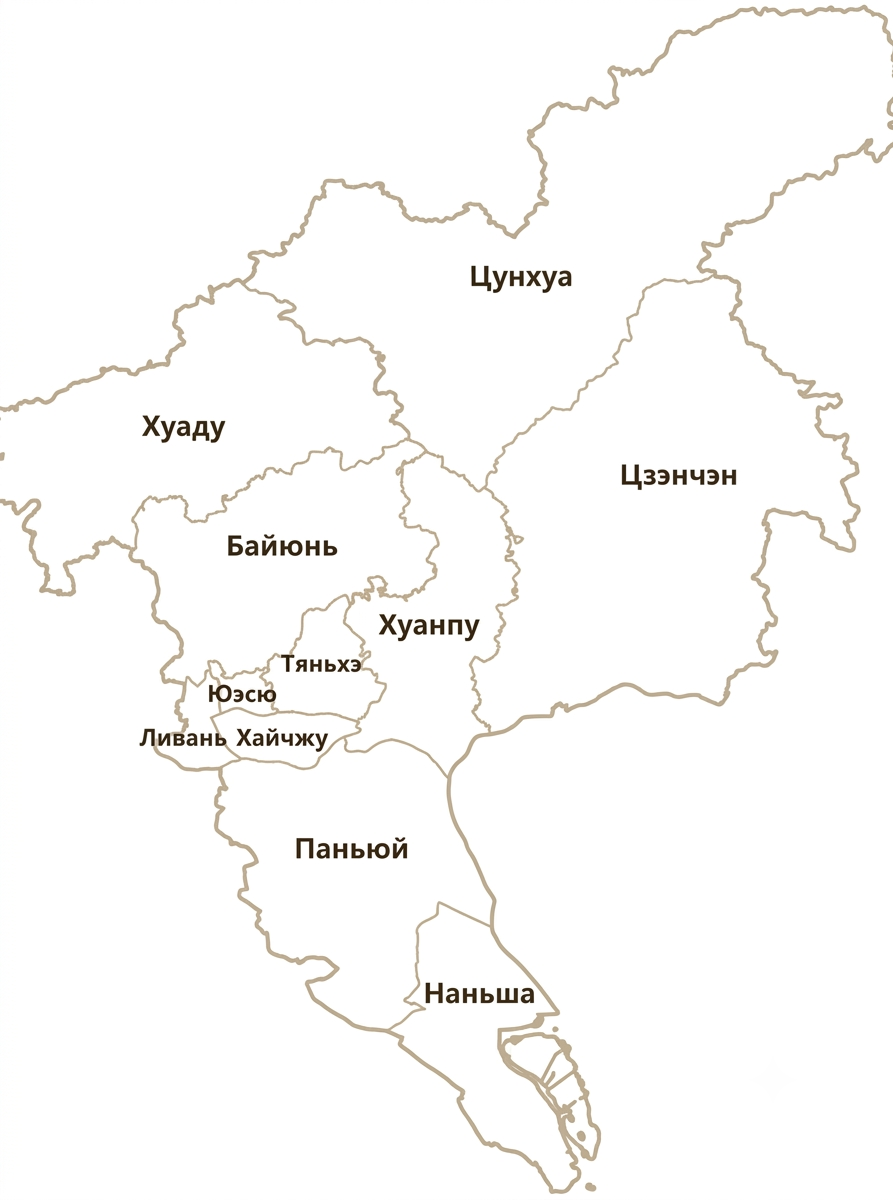
Yuexiu and Tianhe are most expensive; Panyu and Baiyun are most affordable. Liwan is at Hong Kong border, Nansha is the port district.
Currency stability & inflation (15 years)
The ruble-dollar rate fell from 30 to 92 RUB per USD over 15 years (−67% purchasing power), while the yuan stayed in a 6.1–7.1 corridor — only +5% change. Cumulative inflation: Russia +198%, China +33%. This is the key argument for keeping savings in yuan when relocating to Guangzhou.
Exchange rates: RUB/USD and USD/CNY (2010–2024)
annual averagesDual Y-axis: left — rubles per $1, right — yuan per $1. The ruble devalued 3× (2014–2015, 2020, 2022). The yuan stays in a ±8% corridor — this is PBOC policy.
Inflation: Russia vs China (2010–2024)
annual %Russia peak years: 2015 (15.5%), 2022 (11.9%), 2024 (9.5%). China's peak — 5.4% in 2011, then steadily below 3%. Over 15 years cumulative: Russian prices tripled, Chinese prices grew by a third.
Over 15 years the ruble weathered three shocks: 2014–2015 (oil + Crimea), 2020 (COVID), 2022 (sanctions). Each shock — a 30–50% loss of import-purchasing power. Keeping savings in rubles on a 5+ year horizon = guaranteed loss.
The yuan is a managed currency. The PBOC keeps a 6.0–7.3 per dollar corridor. This makes the yuan a predictable savings currency. The RUB/CNY cross-rate changed from 4.5 to 13.0 RUB per CNY over 15 years — the ruble lost 65% against the yuan.
Denomination, currency & war risks to assets
What denomination is and how it affects labour costs, property values and savings. How military conflicts in different cities (Kyiv, Belgorod, Beirut, Tel Aviv, Moscow, hypothetical Guangzhou) affected asset prices — in concrete numbers. All amounts in ₽ / ¥ / $.
What denomination is — in plain words
Denomination (from Latin denominatio — 'renaming') is a change in the face value of money: the government issues new notes and coins, declaring the old ones invalid. Most often, zeros are 'removed' from the denomination: 1 000 old rubles become 1 new ruble. This does not make the population richer — it just simplifies calculations and 'cosmetically' masks accumulated inflation. After the 1998 redenomination in RF, 1 new 5 000 ₽ note corresponds to 5 000 000 'pre-Soviet' rubles of 1997.
Two related concepts are distinguished: denomination (a change in note face value, usually without changing the currency's value) and devaluation (a decrease in the currency's value relative to other currencies, e.g. the ruble falling from 60 to 95 per dollar). Denomination is a 'cosmetic repair' of money, devaluation is a real depreciation. In the RF of 1998, both events occurred simultaneously: denomination 1 000 : 1 (January 1) + devaluation 6.5 : 1 (August).
For citizens, denomination means: (1) old notes are valid for a limited time (usually 1–6 months), then they must be exchanged at a bank; (2) salaries and prices are recalculated 1 : 1 in new money (if the denomination is 1 000 : 1, a salary of 1 000 000 old ₽ becomes 1 000 new ₽); (3) bank deposits are recalculated automatically; (4) debts too. The main risk is psychological: people get confused about prices and often inflate them 'just in case', giving a burst of inflation in the first months after redenomination.
Banknote denominations — RUB / CNY / USD
| Currency | Denominations | Largest | Inflation | Redenominations |
|---|---|---|---|---|
| 🇨🇳 CNY (¥) | 100, 50, 20, 10, 5, 1 ¥ (notes) + 1 ¥, 0.5 ¥, 0.1 ¥ (coins) | 100 ¥ (₽1 090 / ~$14) | 0.5–2.5%/yr (stable) | Never had one — the oldest continuously used currency without redenomination |
| 🇺🇸 USD ($) | 100, 50, 20, 10, 5, 1 $ (notes) + 1¢, 5¢, 10¢, 25¢, 50¢, 1 $ (coins) | 100 $ (₽7 950 / ¥730) | 2–4%/yr (Fed target); peak 9.1% in June 2022 | Never redenominated since 1792 — 233 years of stability |
| 🇷🇺 RUB (₽) | 5 000, 2 000, 1 000, 500, 100, 50 ₽ (notes) + 10, 5, 2, 1 ₽ (coins) | 5 000 ₽ (¥545 / ~$63) | 5–12%/yr; peak 17.8% in April 2022 | 1998 redenomination: 1 000 old ₽ = 1 new ₽ (3 zeros removed) |
Note: the largest Chinese note (100 ¥) is ~$14, while the largest Russian (5 000 ₽) is ~$63. That is, in China for large purchases you physically need more notes. This is because in China everyone uses WeChat Pay/Alipay, and cash is only needed for small purchases. In RF, cash is still important for large transactions, so large notes are needed.
Labour cost — same job in 3 currencies
To understand the real cost of labour, you need to look at the same positions in three currencies. Only then can you see that, for example, a Moscow mid-developer's salary of 250 000 ₽ is not 'more' than 25 000 ¥ in Guangzhou, but roughly the same (~$3 200 vs ~$3 425). The difference is only 7%, while in rubles it seems that Moscow pays 10× more.
| Role | 🇷🇺 Москва (RUB) | 🇨🇳 Гуанчжоу (CNY) | 🌍 US (USD) |
|---|---|---|---|
| Junior IT engineer / Junior dev | 120 000 ₽ ¥13 080 / ~$1 510 | 12 000 ¥ ₽130 800 / ~$1 645 | $1 500 ₽119 250 / ¥10 950 |
| Mid IT engineer / Mid dev | 250 000 ₽ ¥27 250 / ~$3 145 | 25 000 ¥ ₽272 500 / ~$3 425 | $3 200 ₽254 400 / ¥23 360 |
| Senior IT engineer / Senior dev | 450 000 ₽ ¥49 050 / ~$5 660 | 45 000 ¥ ₽490 500 / ~$6 165 | $5 800 ₽461 100 / ¥42 340 |
| Shop assistant | 55 000 ₽ ¥5 990 / ~$692 | 5 500 ¥ ₽59 900 / ~$753 | $700 ₽55 650 / ¥5 110 |
| Cleaner | 40 000 ₽ ¥4 360 / ~$503 | 4 000 ¥ ₽43 600 / ~$548 | $500 ₽39 750 / ¥3 650 |
| Taxi driver (after car/fuel costs) | 100 000 ₽ ¥10 900 / ~$1 258 | 9 000 ¥ ₽98 100 / ~$1 233 | $1 250 ₽99 375 / ¥9 125 |
Asset & property values — relative to currencies
The same asset — for example, 1 m² of housing — looks different in different currencies. To understand whether it is 'expensive' or 'cheap', you need to know the denomination of the largest note. For example, 1 m² in central Moscow costs ~450 000 ₽, which equals 90 of the largest Russian notes (5 000 ₽). In Guangzhou, 1 m² costs 80 000 ¥ = 800 of the largest Chinese notes (100 ¥). In New York — 15 000 $ = 150 of the largest American. This shows that the 'normal' price of 1 m² of housing in any developed country is ≈ 100–200 of the largest local notes.
Historical redenominations — 4 cases
On 1 January 1998, 1 000 'old' rubles of the 1993–1997 series became 1 'new' ruble. 3 zeros removed. Goal — catch up with the 1992–1997 inflation, when prices rose ~5 000×. Citizens had 2 weeks to exchange notes, after which old money ceased to be legal tender. The 1961 redenomination was similar (10 : 1).
On 1 January 2005, 1 million Turkish lira = 1 new Turkish lira. 6 zeros removed. Reason — the 1970–2004 inflation, cumulative ~10¹³. After 2005 the new lira strengthened, and in 2009 the prefix 'new' was dropped. The 'largest' redenomination of the 21st century.
Three redenominations in 13 years. 2008: 1 000 : 1 (bolivar → bolivar fuerte). 2018: 100 000 : 1 (bolivar fuerte → bolivar soberano). 2021: 6 zeros (bolivar soberano → digital bolivar). In total — 1 old bolivar of 2007 = 10¹⁴ digital bolivars of 2021. A textbook example that redenomination without economic reforms is useless.
The largest hyperinflation in history. 2006: 1 000 : 1. August 2008: 10¹⁰ : 1. February 2009: 10¹² : 1. Cumulatively — 10²⁵ : 1. The 100-trillion-Zimbabwe-dollar note of 2008 is the highest denomination in monetary history. In 2009 the Zimbabwe dollar was abolished, the country switched to USD. Redenomination does not save an economy — it is just cosmetics.
Military conflicts and property values — 6 cases
Military conflicts affect property and assets through several channels: (1) physical destruction — zeroing of value; (2) population outflow — falling demand; (3) economic sanctions — falling foreign capital; (4) devaluation of the national currency — formal price growth in local currency while falling in hard currency; (5) closing of the capital account — inability to withdraw money; (6) destruction of infrastructure — depreciation of even undamaged assets. Below — 6 real or hypothetical cases with numbers.
Киев (Kyiv)
Белгород / Курск / Брянск
Бейрут (Beirut)
Тель-Авив / Газа
Москва
Гуанчжоу (гипотетический сценарий)
Practical takeaways for a relocant
Always compare salaries and assets in one currency — preferably USD or CNY. Rubles are misleading due to high inflation and devaluation.
Keep savings in 3 currencies: 40% USD, 30% CNY, 30% RUB — for current expenses. This is basic protection against redenomination/devaluation of any single currency.
When buying property in Russia, calculate the price in USD (at the current rate) — this shows the real cost. The price in ₽ hides devaluation.
If a country redenominated in the last 20 years (RF, Turkey, Venezuela, Zimbabwe, Argentina) — the probability of a new redenomination or devaluation in the next 20 years is higher than in countries without one (USA, Switzerland, UK).
Military conflicts reduce property liquidity — even if the price doesn't fall, selling is hard. Cash reserve in hard currency for 6 months of expenses — minimum cushion.
Geographic diversification: apartment in Moscow + deposit in Hong Kong + stocks in USA — reduces the risk of losing all assets in a single shock. Don't put 'all eggs in one basket'.
Bottom line: currency is a tool, not 'money'. Real value is in what you can buy with it
Denomination is a technical fact about money. Much more important is understanding: (1) in what currency you receive income; (2) in what currency you spend; (3) in what currency you keep savings. If everything is in one currency — you are vulnerable to its devaluation/redenomination. If in three — you have a safety cushion. If real estate is in one country, business in another, savings in a third — you have jurisdictional diversification, and no single conflict zeroes you out. Moving to Guangzhou is not just a change of city, it is an opportunity to diversify currency and jurisdictional risks: part of income in ¥, part in $, part in ₽. Do not keep all assets in one basket — neither currency nor geographic.
Relocation checklist
33 tasks in 5 categories. Check them off as you complete — progress is saved in this browser.